


-

- DISCOVER SIKHISM
- SIKH GURUS
- Sikh Gurus
- Sri Guru Nanak Sahib Ji
- Sri Guru Angad Sahib Ji
- Sri Guru Amar Das Sahib Ji
- Sri Guru Ram Das Sahib Ji
- Sri Guru Arjan Sahib Ji
- Sri Guru Hargobind Sahib Ji
- Sri Guru Har Rai Sahib Ji
- Sri Guru Harkrishan Sahib Ji
- Sri Guru Tegh Bahadur Sahib Ji
- Sri Guru Gobind Singh Sahib Ji
- Sri Guru Granth Sahib Ji
- GURDWARAS
- SIKH LIBRARY
- DAILY HUKAMNAMA
- MORE
- KIRTAN
- LIVE TV
- ABOUT US

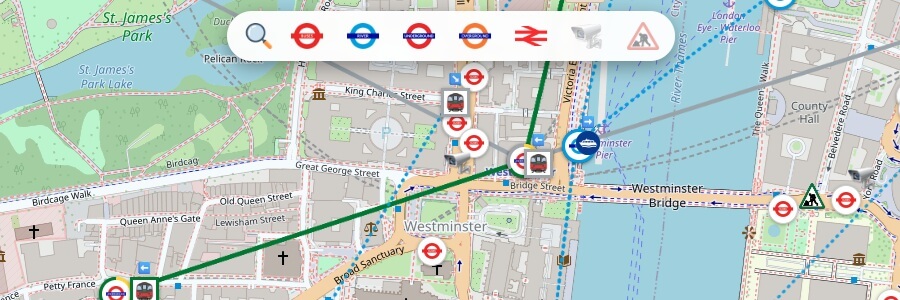
Live London Transport & Traffic Map
A small act of sewa for everyone travelling across London.
Sikhi teaches that faith is lived not only through prayer and learning, but through sewa — selfless service. While many people associate sewa with preparing langar or volunteering in the community, sewa also extends to using our skills, knowledge and time to make everyday life a little easier for others. Technology is no exception.
A Small Act of Sewa
This interactive London transport and traffic map has been developed by Discover Sikhism using publicly available Transport for London (TfL) Open Data. It brings together live London bus routes and arrival information, the London Underground, London Overground, Elizabeth line, Docklands Light Railway (DLR), London Trams, National Rail services, River Bus routes, traffic cameras and live road incidents into a single, easy-to-use map.
You can search for bus routes, stops and stations across Greater London, monitor public transport services, and view live traffic information to help plan journeys more efficiently. The map works on desktop computers, tablets and mobile devices without requiring registration or payment.
Features
◾ Live London bus tracking and arrival predictions
◾ London Underground, Overground, Elizabeth line, DLR and Tram services
◾ National Rail and River Bus information
◾ Traffic cameras and live road incidents
◾ Search for bus routes, stops and stations
◾ Interactive map designed for desktop and mobile devices
◾ Free to use with no advertising or subscription
The service is provided free of charge as a practical contribution to the wider community, regardless of religion, background or destination. If it helps make someone's journey a little easier, then it has served its purpose.
 Launch the Live London Transport & Traffic Map
More Tools for Travellers
As part of the same spirit of sewa, we have also developed tools that help people plan their journeys more efficiently. While the London Transport Map focuses on public transport across London, our Fastest Multi-Stop Route Planner is designed for journeys anywhere in the world where multiple destinations need to be visited.
The route planner helps you find the most efficient order for visiting multiple locations, whether you are planning a pilgrimage, visiting historic sites, organising a road trip, managing business visits, or simply trying to reduce unnecessary driving.
Many navigation services provide directions between locations in the order they are entered. Our route planner takes a different approach by analysing the complete journey and calculating a more efficient sequence of stops, helping save travel time, fuel costs and vehicle emissions.
Fastest Multi-Stop Route Planner
◾ Optimise journeys with multiple destinations
◾ Calculate fastest round trips or A-to-Z journeys
◾ Add locations by address, place name or coordinates
◾ Bulk import multiple locations
◾ View routes on an interactive map
◾ Open completed routes in Google Maps
Launch the Fastest Multi-Stop Route Planner
Learn more about the Route Planner and how it works
Why History Matters
There is a profound irony in the sewa offered above. The Sikh community has contributed enormously to Britain through military service, sacrifice, enterprise and public life, yet it also carries the memory of repeated betrayals by successive British governments. Yet Sikhi teaches that sewa is not conditional. Service is offered because it reflects who Sikhs are, not because history has always been fair in return.
Forgiveness, however, should not become forgetfulness. A society cannot build genuine understanding by ignoring the experiences of those who have suffered injustice. History matters because the decisions of governments, the breaking of promises and the treatment of communities do not disappear with time. They shape identities, memories and relationships across generations.
The Long History of British Betrayal of the Sikhs examines more than two centuries of British actions and policies affecting the Sikh community — from the annexation of Punjab in 1849, through periods of sacrifice and broken assurances, to contemporary controversies involving British Sikhs today. Drawing upon treaties, government records, historical research and recent developments, it examines recurring themes in that history and asks whether some of its consequences still shape the relationship between the Sikh community and British institutions today.
The Long History of British Betrayal of the Sikhs