


-

- DISCOVER SIKHISM
- SIKH GURUS
- Sikh Gurus
- Sri Guru Nanak Sahib Ji
- Sri Guru Angad Sahib Ji
- Sri Guru Amar Das Sahib Ji
- Sri Guru Ram Das Sahib Ji
- Sri Guru Arjan Sahib Ji
- Sri Guru Hargobind Sahib Ji
- Sri Guru Har Rai Sahib Ji
- Sri Guru Harkrishan Sahib Ji
- Sri Guru Tegh Bahadur Sahib Ji
- Sri Guru Gobind Singh Sahib Ji
- Sri Guru Granth Sahib Ji
- GURDWARAS
- SIKH LIBRARY
- DAILY HUKAMNAMA
- MORE
- KIRTAN
- LIVE TV
- ABOUT US

Fastest Multi-Stop Route Planner
If you are planning a journey to visit several historic Sikh gurdwaras, our Fastest Multi-Stop Route Planner can help you work out a more efficient way of making the journey.
When visiting multiple gurdwaras, the order in which you visit them can make a significant difference to the total distance you travel and the time you spend on the road. Rather than simply travelling from one destination to the next in the order they were entered, our route planner analyses your stops and calculates a more efficient sequence.
The result can be a shorter journey, less time driving, lower fuel costs and reduced CO2 emissions.
Launch the Route Planner
 Fastest Multi-Stop Route Planner – Find a more efficient route between multiple destinations.
Features
◾ Optimise journeys with up to 100 locations.
◾ Calculate the fastest round trip or A→Z journey.
◾ Add locations by address, postcode, place name or latitude and longitude.
◾ Bulk import multiple destinations with one entry per line.
◾ Open the completed route directly in Google Maps.
◾ Ideal for road trips, visiting Gurdwaras, deliveries, sightseeing and business travel.
◾ Free to use on desktop, tablet and mobile devices.
Why Use a Multi-Stop Route Planner?
There are many excellent mapping and navigation services available, including Google Maps. These services are extremely useful for finding driving directions between locations, but planning a journey involving many destinations is a different problem.
For example, suppose you are visiting several Sikh gurdwaras in Punjab. You may have a list of ten places that you would like to visit, but there is no particular reason why they should be visited in the order in which you wrote them down.
If you enter the destinations in that order and follow the resulting route, you may find yourself travelling in one direction, then doubling back, before travelling through an area you had already passed earlier in the journey.
The individual directions may be perfectly good, but the overall journey may not be the most efficient way of visiting all the destinations.
This is where our Multi-Stop Route Planner can help.
How Is This Different From Google Maps?
Google Maps is primarily a navigation service. You tell it where you want to go, and it provides directions for getting there. It can also handle multiple destinations, making it a very useful tool once you know the route you want to take.
Our route planner approaches the problem from a different direction. Instead of simply following the order in which your destinations were entered, it is designed to optimise the order of the stops before you start your journey.
In simple terms:
- Google Maps: “These are my destinations. Give me directions between them.”
- Our Route Planner: “These are all the places I want to visit. What is the most efficient order in which to visit them?”
Once the route has been optimised, you can then open the completed journey in Google Maps and use it for detailed driving directions.
So the two tools can complement each other: the Route Planner helps you decide the order; Google Maps helps you navigate the journey.
How It Works
Adding locations is simple. Enter an address, postcode, place name or latitude and longitude, then add the location to the map. The first location entered becomes the starting point of your journey.
If you already have a list of destinations, you can use Bulk Add Locations to paste multiple locations at once, with one location on each line.
You can then choose between two optimisation options:
- Fastest Round Trip – The journey starts and finishes at the same location, while the destinations in between are reordered to create an efficient route.
- Fastest A→Z Trip – The journey starts at your first location and finishes at your last location, while the destinations between them are optimised.
You can also edit or remove any location by clicking its marker on the map.
Visiting Sikh Gurdwaras in Punjab
One of the reasons we developed this route planner was to help people visiting the many historic Sikh gurdwaras and important Sikh sites across Punjab.
There are numerous gurdwaras and historical sites that you may wish to visit during a trip, but they are spread across a large area. Planning the order in which you visit them can therefore make a substantial difference to the overall journey.
For example, imagine you are staying in the village of Rode, Punjab, and would like to visit several historic Sikh gurdwaras before returning to Rode.
Your journey might include:
1. From Rode, Punjab (30.681147, 75.017379)
2. Gurdwara Sri Darbar Sahib Baba Bakala (31.555242, 75.263951)
3. Gurdwara Sri Fatehgarh Sahib (30.652275, 76.393058)
4. Gurdwara Sri Garhi Sahib Chamkaur (30.897598, 76.414002)
5. Gurdwara Sri Goindwal Sahib (31.364326, 75.144898)
6. Gurdwara Sri Patal Puri Sahib, Kiratpur (31.178058, 76.563232)
7. Sri Akal Takht (31.620689, 74.875394)
8. Takht Sri Damdama Sahib (29.987048, 75.078571)
9. Takht Sri Keshgarh Sahib (31.235004, 76.498828)
10. Back to Rode, Punjab (30.681147, 75.017379)
These destinations cover a considerable area of Punjab. If they are visited in an arbitrary order, you could end up travelling considerably further than necessary.
What Happens If You Don't Optimise the Route?
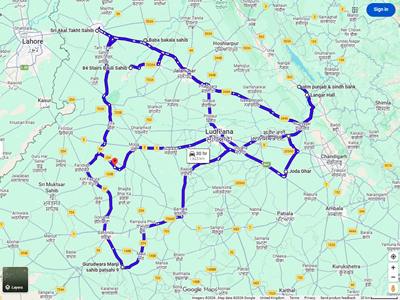
To demonstrate the difference, we entered the destinations into Google Maps in the original order shown above.
At the time this comparison was made, the journey produced by Google Maps was approximately 1,623 km and would take around 30 hours of driving, assuming continuous driving and excluding stops, breaks and traffic delays.
The problem is not that the individual directions are incorrect. The problem is that the sequence of destinations creates an inefficient overall journey.
When you have many destinations, the difference between a good sequence and a poor sequence can become very significant.
Now Optimise the Same Journey
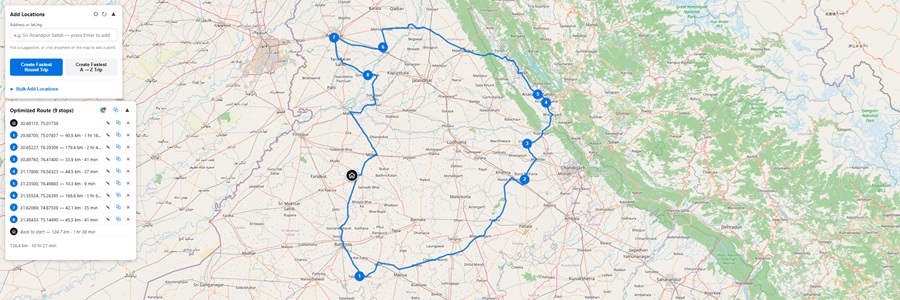
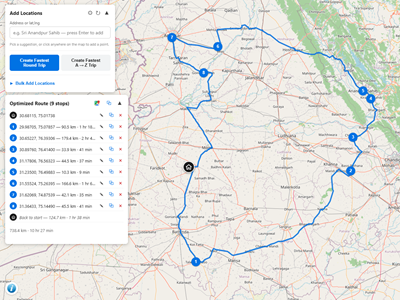
We then entered the same destinations into our Route Planner and selected Fastest Round Trip.
The Route Planner rearranged the destinations into a more efficient sequence, producing a journey of approximately 738 km with a driving time of around 10 hours and 27 minutes.
That is a difference of approximately 885 km and more than 19½ hours of driving.
Of course, these figures are an example and actual distances and driving times can change as roads, restrictions and mapping data change. The purpose of the comparison is to demonstrate how important the order of multiple destinations can be.
The Difference Is the Order
It is worth emphasising that the Route Planner is not necessarily finding a completely different road between each pair of locations. The major difference is which destination you visit next.
Consider a simple example. If you have four gurdwaras to visit, there may be several possible sequences:
Rode → A → B → C → D → Rode
or:
Rode → C → A → D → B → Rode
Both journeys visit exactly the same places. However, one sequence may require considerably more backtracking than the other.
When the number of destinations increases, manually working out the best sequence becomes increasingly difficult. This is the problem the Multi-Stop Route Planner is designed to solve.
Plan Your Gurdwara Journey
Whether you are making a short trip to visit a few nearby gurdwaras or planning a longer pilgrimage across Punjab, it is worth considering the order in which you visit each location.
Rather than entering your destinations into a navigation app and simply accepting the resulting sequence, use the Multi-Stop Route Planner to find a more efficient order first.
You can then use Google Maps or your preferred navigation service to follow the completed route.
Plan the order first. Navigate the journey second.
Open the Fastest Multi-Stop Route Planner