


-

- DISCOVER SIKHISM
- SIKH GURUS
- Sikh Gurus
- Sri Guru Nanak Sahib Ji
- Sri Guru Angad Sahib Ji
- Sri Guru Amar Das Sahib Ji
- Sri Guru Ram Das Sahib Ji
- Sri Guru Arjan Sahib Ji
- Sri Guru Hargobind Sahib Ji
- Sri Guru Har Rai Sahib Ji
- Sri Guru Harkrishan Sahib Ji
- Sri Guru Tegh Bahadur Sahib Ji
- Sri Guru Gobind Singh Sahib Ji
- Sri Guru Granth Sahib Ji
- GURDWARAS
- SIKH LIBRARY
- DAILY HUKAMNAMA
- MORE
- KIRTAN
- LIVE TV
- ABOUT US

Sarbloh Bibek: A Disciplined Path Within Khalsa Rehat
Preserving Khalsa identity and spiritual focus through discipline and devotion
Introduction
Among the many spiritual disciplines within the Khalsa Panth, Sarbloh Bibek remains one of the most profound—yet often misunderstood—aspects of Gurmat Rehat. Rooted in the spiritual vision of Guru Gobind Singh Ji, this discipline extends far beyond dietary observance. It functions as a structured way of living that seeks to preserve spiritual awareness, maintain sangati discipline, and nurture a life centred on Naam Abhiyaas.
In the modern era, Sarbloh Bibek is sometimes viewed as unnecessary or overly strict. However, within the teachings of traditional Bibeki Gursikhs—most notably Bhai Sahib Bhai Randhir Singh Ji—it is upheld as a deeply transformative discipline that supports spiritual growth and inner clarity.
While the Sikh Rehat Maryada establishes a shared baseline for the Panth, practices such as Sarbloh Bibek represent a more rigorous expression of Gurmat Rehat, preserved within specific traditions of the Khalsa.
What is Sarbloh Bibek?
Sarbloh Bibek is a disciplined spiritual practice, primarily upheld by Amritdhari Sikhs within the Bibeki tradition. It consists of three interrelated dimensions:
1. Sarbloh (All-Iron)
Food is prepared and consumed exclusively in iron (sarbloh) utensils. This practice recalls the Sarbloh Bata used during Amrit Sanchaar and symbolizes strength, resilience, and the sovereign spirit of the Khalsa.
2. Bibek (Spiritual Discernment)
Bibek refers to the cultivation of inner awareness—discriminating between what supports spiritual growth and what distracts from it. This includes attentiveness not only to food, but to influences on the mind and consciousness.
3. Rehat (Disciplined Living)
Food is prepared with devotion, accompanied by the recitation of Gurbani and remembrance of Waheguru. In this way, nourishment becomes spiritually aligned rather than merely physical.
Together, these elements form a lifestyle aimed at preserving spiritual focus and strengthening the Khalsa's distinct identity (ਨਿਆਰਾਪਨ).
Sarbloh: The Chosen Medium
Guru Gobind Singh Ji's use of iron in foundational Khalsa practices is deeply significant. Sarbloh is present in:
◾ The Khanda used in the preparation of Amrit
◾ The Bata from which Amrit is administered
◾ The Kirpan carried by the Khalsa
Within the Bibeki understanding, this consistent use of Sarbloh reflects intentionality rather than coincidence. As articulated by Bhai Sahib Bhai Randhir Singh Ji in Gurmat Bibek, Sarbloh becomes associated with discipline, strength, and spiritual focus in the life of a Gursikh.
In this view, Sarbloh is not merely a material choice—it serves as a practical aid in cultivating a lived connection to Rehat and Naam.
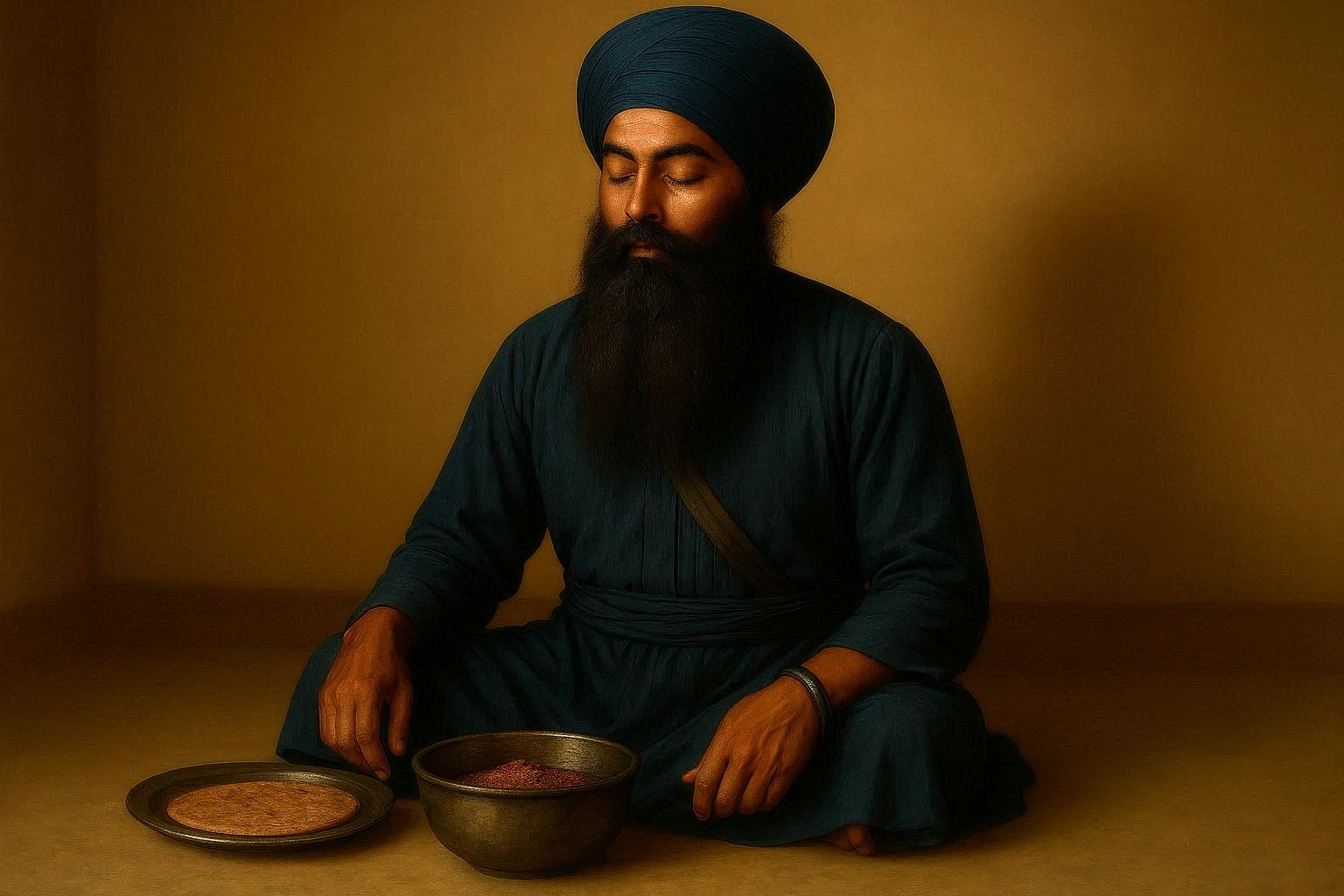
A Khalsa Sikh practicing Sarbloh Bibek, with food prepared in iron utensils with devotion and spiritual focus.
Rehat and Discipline
Within the Bibeki tradition, Sarbloh Bibek is understood as an integrated expression of Khalsa discipline:
◾ External discipline supports internal clarity: Physical practices reinforce mental and spiritual awareness.
◾ Rehat sustains Amrit: Receiving Amrit is the beginning; living in disciplined alignment allows its spiritual effect to deepen.
◾ Distinct identity is lived, not symbolic: The uniqueness of the Khalsa is maintained through consistent practice.
◾ Shared discipline strengthens unity: Practices such as partaking from a common Sarbloh Bata during Amrit Sanchaar reflect unity through shared Rehat.
While practices vary across the global Sikh community, this perspective maintains that disciplined living plays a central role in preserving spiritual cohesion.
Spiritual Significance
◾ Inner Protection
Just as Bana and Dastar provide an external identity, disciplined living acts as a safeguard against internal distraction and spiritual dilution.
◾ Naam-Centred Living
Food prepared with remembrance of Waheguru becomes more than sustenance—it supports a consciousness oriented toward Naam.
◾ Discipline as Foundation
Rehat creates the conditions in which Naam can steadily dwell within one's awareness.
Bibeki teachings often emphasise that while spiritually elevated individuals may transcend formal disciplines, such exceptions do not define the path for most practitioners. Structured discipline exists to support consistency and growth.
Challenges in the Modern Context
In contemporary life, the observance of Sarbloh Bibek has declined in many settings. Factors contributing to this include:
◾ Changing lifestyles and urban environments
◾ Practical constraints in global diaspora communities
◾ Diverse interpretations of Rehat across the Panth
Additionally, even among those who uphold Bibek, differences in interpretation can sometimes lead to division—particularly when humility is overshadowed by rigidity or ego (Haumai).
These challenges highlight that the preservation of any discipline requires not only outward practice, but also inward qualities such as humility, understanding, and mutual respect.
Conclusion
For those who follow the Bibeki tradition, Sarbloh Bibek is a meaningful and disciplined path that supports spiritual awareness, strengthens identity, and nurtures a life centred on Naam.
Its continued relevance lies not in compulsion, but in its ability to offer structure, clarity, and focus in an increasingly complex world.
A thoughtful engagement with such disciplines may include:
◾ Reflecting on the role of Rehat in daily life
◾ Approaching tradition with both sincerity and understanding
◾ Strengthening unity through shared values rather than division
◾ Anchoring all practices in Naam Abhiyaas
"Without fully knowing the Rehat of a Gursikh, another Gursikh should not accept food from their hands… this is a very high Bibeki Karam."
In this light, Sarbloh Bibek can be understood as a disciplined pathway—one that seeks to help the Khalsa remain spiritually aware, grounded, and aligned with its essential purpose.
 Back to Gurmat Gyan (English) List