


-

- DISCOVER SIKHISM
- SIKH GURUS
- Sikh Gurus
- Sri Guru Nanak Sahib Ji
- Sri Guru Angad Sahib Ji
- Sri Guru Amar Das Sahib Ji
- Sri Guru Ram Das Sahib Ji
- Sri Guru Arjan Sahib Ji
- Sri Guru Hargobind Sahib Ji
- Sri Guru Har Rai Sahib Ji
- Sri Guru Harkrishan Sahib Ji
- Sri Guru Tegh Bahadur Sahib Ji
- Sri Guru Gobind Singh Sahib Ji
- Sri Guru Granth Sahib Ji
- GURDWARAS
- SIKH LIBRARY
- DAILY HUKAMNAMA
- MORE
- KIRTAN
- LIVE TV
- ABOUT US

1984 Delhi Genocide - Silence Of The Lambs
|
|
|
|
|
|
|
|

Over 15 years after he recommended that criminal cases be filed against Congress leaders Har Kishan Lal Bhagat and Sajjan Kumar for allegedly leading mobs that killed hundreds of Sikhs in Delhi in 1984, DK Aggarwal, a retired DGP of Uttar Pradesh, is reluctant to comment on the recent developments.
"It's pointless," he says. "The decision lies with the politicians." Coax him further and he says, "They did appear to be involved. But our legal system is such that once a long time lapses, the evidence gets diluted, sometimes even tutored, thereby rendering it unreliable."
Aggarwal and retired Delhi High Court judge JD Jain were appointed in December 1990 to head a committee to investigate the Sikh massacre that followed Prime Minister Indira Gandhi's assassination on October 31, 1984.
This inquiry — the sixth since the carnage — was wound up in August 1993 and its recommendations ignored.
It was on the basis of the recommendations of a subsequent commission headed by retired Supreme Court judge GT Nanavati (the 10th such inquiry) that three cases against Sajjan Kumar were finally registered in August 2005.
The first case relates to the killing of 18 Sikhs in the Raj Nagar area of Delhi Cantonment, in which five witnesses told the Central Bureau of Investigation (CBI) that they saw Sajjan Kumar leading the mob.
Nirpreet Kaur, who testified before the CBI against Kumar, told Tehelka that on the morning of November 2, she saw Kumar standing in a police jeep and announce: "No Sikh should live. Any house that shelters Sikh families will be burnt.
In the second case of the Sultanpuri area of northwest Delhi, six witnesses identified Sajjan Kumar as leading that mob. But the police are yet to file the chargesheets in the two cases. The investigation in the third case was shelved.
"Why should the police wait? There is sufficient evidence to prosecute Kumar," says HS Phoolka, Supreme Court advocate and counsel for many of the victims.
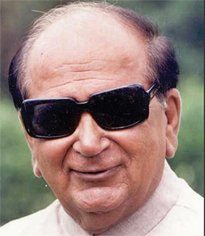
HKL Bhagat - was known as a strong Indira Gandhi loyalist |
What The Eye Saw
11 witnesses told CBI that Kumar led the mobs in two places
Kumar threatened that homes that sheltered Sikhs would be burnt
Lawyer Phoolka says there is enough evidence to prosecute him
The Manipulation
The police did not file any charge sheets in two cases
Investigations in a third case were shelved for reasons not known
Tehelka sting in 2005 exposed how middlemen tried to bribe witnesses
In its October 8, 2005 issue (Carnage 84: The Ambushing of Witnesses), Tehelka exposed the middlemen who acted on behalf of Bhagat and Kumar to either threaten or pay off key eyewitnesses and survivors of the massacre.
Anek Kaur, whose husband was brutally killed, had filed an affidavit giving damning details of the roles of Sajjan Kumar and two of his associates, Jai Singh and Jai Kishan. She said even the police instigated the mob to kill the Sikhs. But in 1994, Anek withdrew her statement against Sajjan Kumar.
Her mother-in-law, Sahibzadi, later confessed in a Tehelka sting operation that a man she could identify only as Rathi had obtained Anek's thumb impression on some paper. Subsequently, he began buying their rations.
Anek's late husband's sister, Mishri Kaur, also caught on hidden camera, admitted that Sajjan Kumar had offered to buy them a flat in exchange for Anek to withdraw her charges against him. She said Sajjan Kumar also offered to pay their lifelong expenses.
The family was indeed paid for two years. "Before her [Anek's] death [in 2001] she told me and her daughter to take money from Sajjan or else depose against him," Mishri recalled on the spycam. Anek also told her: "Take it that he is the murderer of your parents."
That over a dozen committees were established but summarily wound up indicates a lack of political will to deliver justice to the Sikhs. At times, the government even contradicted the probe findings. For example, the Nanavati Commission referred to a man named Kher Singh who witnessed one such massacre.
Kher Singh's affidavit said he had seen "local MP Sajjan Kumar addressing a crowd of persons and telling them that Sikhs had killed their mata[mother] and that no Sikh in the area should be spared".
Anek Kaur had accused Sajjan Kumar of leading the mobs. But in 1994, she withdrew the charge. Her sister-in-law says Kumar offered to buy Anek a flat if she withdrew her affidavit against him
But Tehelka's investigation showed that the government's Action Taken Report said the opposite: "No eyewitness came forward to give any specific evidence or clue about the incident. Therefore the case was sent as untraced which was accepted by the competent court."
Two witnesses — Satnami Bai and Darshan Kaur — had testified against Bhagat but the case against him collapsed in 1995 after Satnami turned hostile. Darshan was unwavering despite threats to her life and continued to name Bhagat. But the damage was done. Nanavati held that that the former Union minister could not be prosecuted because the testimony of just one witness wasn't enough to convict him.

Satnami Bai - a witness won over |
Witness Crumbles
Sikh leader Lubhana offered Satnami Rs 12 lakh as a bribe
Satnami told a panchayat she was forced to turn hostile
Satnami told Tehelka Bhagat's men threatened to kill her children
Upright Witness
Darshan Kaur said Lubhana offered her Rs 25 lakh as bribe
Lubhana beat her after she refused to give in to his intimidation
On this issue, the Akal Takht in Amritsar summoned Lubhana
The Tehelka investigation also revealed that a prominent Sikh leader of Tilak Vihar in west Delhi, Atma Singh Lubhana, had struck a deal to pay Satnami Rs 12 lakh for her to change her statement.
Satnami was questioned about this deal at a panchayat in 1996 held at Gurdwara Shaheedgunj in Tilak Vihar, according to a document of the Delhi Sikh Gurudwara Management Committee (DSGMC), the influential nodal agency that manages Sikh religious bodies.
In the presence of the widows and other victims of 1984, she swore by the Guru Granth Sahib that Lubhana, a former DSGMC member, had offered her Rs 12 lakh and was instrumental in turning her hostile. Later, on Tehelka's spycam, Satnami admitted to changing her statement because of threats to her life, but denied receiving the money.
"Bhagat's goons threatened me that if I did not change my statement, they would kill my brothers and children," she said. "We were already living in extreme fear, so I succumbed [to the pressure]."
The other victim, Darshan Kaur, told Tehelka that Lubhana had offered her Rs 25 lakh to turn hostile. When she refused, he beat her up. (For this, the Akal Takht in Amritsar, the highest Sikh temporal seat, summoned Lubhana in 1998.) Lubhana confessed on Tehelka's spycam that he paid the Rs 5.28 lakh fine the panchayat had imposed on him but denied threatening Darshan.
Satnami Bai and Darshan Kaur testified against Bhagat, but Satnami turned hostile. Nanavati Commission said Bhagat can't be prosecuted on the testimony of just one witness
Bhagat passed away on October 29, 2005, taking with him forever many details of the largest killings of Sikhs that took place in his east Delhi constituency.
Perhaps the Sikh massacres would have continued to fade away, but for the Delhi journalist, Jarnail Singh, who hurled his shoe at Union Home Minister P Chidambaram this month to protest the CBI's exoneration of Congress leader Jagdish Tytler who, too, allegedly led the killer mobs but was never prosecuted.
The hurried decision of the Congress to withdraw the nominations of Tytler and Kumar for the Lok Sabha election has elated the Sikhs. But the victims' lawyer, Phoolka, warns that the withdrawal of such nominations is only a temporary relief. "This is not the conclusive end," says Phoolka. "The fight goes on because the core issue is still not addressed."
Credit: Shobhita Naithani - Tehelka.com (25th April 2009)
 Back to More Important Articles To Read