


-

- DISCOVER SIKHISM
- SIKH GURUS
- Sikh Gurus
- Sri Guru Nanak Sahib Ji
- Sri Guru Angad Sahib Ji
- Sri Guru Amar Das Sahib Ji
- Sri Guru Ram Das Sahib Ji
- Sri Guru Arjan Sahib Ji
- Sri Guru Hargobind Sahib Ji
- Sri Guru Har Rai Sahib Ji
- Sri Guru Harkrishan Sahib Ji
- Sri Guru Tegh Bahadur Sahib Ji
- Sri Guru Gobind Singh Sahib Ji
- Sri Guru Granth Sahib Ji
- GURDWARAS
- SIKH LIBRARY
- DAILY HUKAMNAMA
- MORE
- KIRTAN
- LIVE TV
- ABOUT US

1984 Delhi Sikh Genocide - Sikh Extermination
|
|
|
|
|
|
|
|
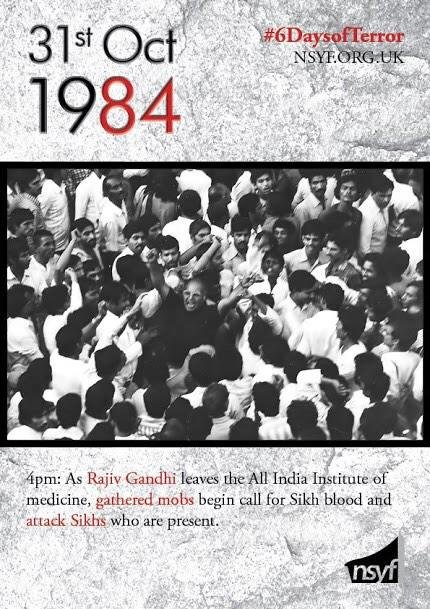
While waiting to hear news of Mrs. Gandhi's physical condition on October 31, the group in front of the AIIMS quickly slipped from shock to revenge, chanting angry slogans such as "Khoon ka Badla Khoon Se," or "Blood for Blood." When President Giani Zail Singh, himself a Sikh, arrived at AIIMS around 5:20 p.m., 15 to 20 people stoned his car and made him the first target of their call for revenge.
The affidavits show that the violence on October 31, however, remained confined to the areas around the AIIMS, and did not result in the deaths of Sikhs. Placing blame on the entire Sikh community, mobs assaulted Sikhs, pulled them out of cars and off buses, and burned their turbans, but no assailant killed a Sikh. Many people reported that their neighborhoods were peaceful on October 31.
Planning For Genocide
During the night of October 31 and early morning of November 1, Congress (I) party leaders met with their local supporters to implement their plan to massacre Sikhs and distribute weapons and money. Congress (I) Member of Parliament (MP) Sajjan Kumar and Congress (I) Trade Union Leader and Metropolitan Councilor Lalit Maken paid 100 Rupees and distributed a bottle of liquor to each assailant.
|
Jagjit Singh of Kiran Garden witnessed a meeting near his house around 8 a.m. where Sajjan Kumar distributed iron rods from a parked truck to about 120 people. The MP instructed the mob to attack Sikhs, kill them, and loot and burn their properties.
On the morning of November 1, Congress (I) MP Sajjan Kumar was identified near at least the following Delhi areas: Palam Colony around 6:30 to 7 a.m., Kiran Gardens around 8 to 8:30 a.m., and Sultanpuri around 8:30 to 9am Raj Kumar of Palam Colony, a hindu, was returning from the market after deciding not to open his shop on November 1.
When he reached the Palam Railway main road, he saw a jeep coming towards him, followed by people on scooters, motorcycles and foot. MP Sajjan Kumar, whom he recognized from Kumar's visits to Palam Colony, sat in the passenger seat. The people following the jeep told him they were going to a meeting at Mangolpuri. By the time Raj Kumar reached the meeting, Sajjan Kumar had started speaking.
Although Raj Kumar could not hear Sajjan Kumar, he heard the mob's deadly answers to Sajjan Kumar's calls: "Sardaroo Ko Mar Do," [Kill the Sardars] "Indira Gandhi Hamari Ma Hai – Aur Inihoo Ne Ushey Mara Hai" [Indira Gandhi is our Mother, and These People Have Killed Her].
Moti Singh witnessed Sajjan Kumar's meeting at a park in Sultanpuri. Having served in the Congress (I) party for 15 to 20 years, Moti Singh recognized many of the attendees, such as Kumar's personal assistant Jai Chand Jamadar. From the rooftop of his house, Moti Singh heard Sajjan Kumar say:
What Price For The Head Of A Sikh?
"Whoever kills the sons of the snakes, I will reward them. Whoever kills Roshan Singh [son of Moti Singh] and Bagh Singh will get 5000 rupees each and 1000 rupees each for killing any other Sikhs. You can collect these prizes on November 3 from my personal assistant Jai Chand Jamadar."
Two policemen, SHO Bhatti and a constable, also attended the meeting. Moti Singh described how early the next morning, these police officers shot and killed his son Roshan Singh, and then shot and killed his two grandsons as they rushed to help their father.
Sarup Singh lived across from eminent Congress (I) leader Shyam Singh Tyagi in Shakarpur. On the evening of October 31, he saw MP and Minister of State for Information and Broadcasting HKL Bhagat standing in front of Tyagi's house talking to four or five people. They went inside Tyagi's house, while Tyagi left to gather more people.
Sukhan Singh Saini, a hindu, witnessed the same meeting and recognized Shyam's brother Boop Singh Tyagi, as well as 13 other people. He also saw Bhagat distribute money to Boop Tyagi, ordering "Keep these two thousand rupees for liquor and do as I have told you….You need not worry at all. I will look after everything."

|
The night of October 31, in Palam Colony, local Congress (I) leader Balwan Khokhar, later identified as leading many of the murderous mobs, convened a meeting at the Ration Shop run by Pandit Harkesh. As Sampuran Singh Chambal slowed down and passed by, they pointed at him and said: "These are the people who had killed Mrs. Gandhi."
Shankar Lal Sharma, an active Congress (I) member, also convened a meeting at his shop at 8:30am on November 1, exhorting the attendees to swear to kill Sikhs. One of the attendees S.M. Umar subsequently went to warn his Sikh friend Sujan Singh to leave Delhi.
Congress party leaders who owned oil depots provided the crucial access to abundant amounts of kerosene – a resource too expensive for most of the assailants to afford. The use of kerosene as the chief weapon demonstrates the assailants' and organizers' intent to kill, rather than injure, the Sikhs, by brutally burning them to death.
In Sultanpuri, where over 400 Sikhs were killed, Cham Kaur witnessed an early morning meeting led by MP Sajjan Kumar and Brahmanand Gupta, owner of an oil depot and president of A/4 Block, Congress (I). In her affidavit, Cham Kaur also named 20 other people attending the meeting in Block B/2. As in other meetings, Sajjan Kumar instructed the crowd to kill Sikhs, and to loot and burn their properties. When Cham Kaur heard those instructions, she rushed home to warn her family.
Jatan Kaur witnessed the same meeting and also heard Sajjan Kumar's instructions. On November 2, when a mob attacked her house, she recognized Congress (I) leader Brahmanand Gupta – the provider of kerosene – leading the mob. Similar meetings were convened elsewhere, such as in Cooperative Colony in Bokaro, where P.K. Tripathi, President of the Congress (I) local unit and also owner of a petrol pump in Nara More, convened a meeting and provided kerosene to death squads.
Cars carrying extra petrol also accompanied mobs. Aseem Shrivastava, a Masters student at the Delhi School of Economics described how motorcycles accompanied mobs in order to provide kerosene, and supplies were continuously replenished:
The attack on Sikhs and their property in our locality appeared to be an extremely organized affair… There were also some young men on motorcycles, who were instructing the mobs and supplying them with kerosene oil from time to time. On more than a few occasions we saw auto-rickshaw arriving with several tins of kerosene oil and other inflammable material such as jute-sacks.
According to late journalist Ivan Fera, a senior official in the Home Ministry also claimed that subsequent investigations of burned businesses demonstrated the use of a combustible chemical substance, whose provision required large-scale coordination.
In its written arguments to the Misra Commission, the Delhi Sikh Gurudwara Management Committee (DSGMC) identified 70 affidavits citing the use of a highly inflammable chemical substance. Eyewitness accounts confirm the use of a chemical substance, in addition to kerosene oil, as well.
Identification and Tracking of Sikhs Killed
In addition to distributing weapons during these meetings, Congress party officials also provided assailants with voter, school registration and ration lists – generated in advance with the particulars of each Sikh resident in the various neighbourhoods. In many neighbourhoods, the assailants marked the houses of Sikhs on October 31, the night before the initiation of the massacres.
The lists provided precise information on the location of Sikh houses and businesses, necessary to distinguish the targets among unmarked residences in diverse neighbourhoods. Because many of the assailants were Jats and Gujjars from neighbouring villages, and locals from the Scheduled Castes, among others, they were illiterate; Congress (I) leaders provided the necessary help in reading the lists.
These lists allowed the assailants, led by Congress (I) leaders and neighbours, to accurately pinpoint the location of any Sikh, and surpass the mere slaughter of Sikhs in the streets. Aunkar S. Bindra was the only Sikh in a house of seven tenants in Cooperative Colony, Bokaro. When the mob came to kill him on November 1, his landlady insisted that no Sikh lived in the house. The mob however pointed to exactly where he stayed.

|
Similarly, when one of G.B. Singh's military friends came to rescue him from Safdarjung Enclave in Delhi, a mob asked the driver why he was protecting the house of a Sikh. The driver replied that he did not know any Sikhs lived there, but the mob answered with precision: "We know Col. Jagjit Singh lives [here]. Mr. G.B. Singh the gentleman with one arm stays downstairs."
The mobs attacked all members of Sikh society, regardless of their stature and position. A relief camp on Palam Road, for example, served survivors who worked for the defence services. Captain Manmohan Singh, a highly decorated officer for his gallantry in the Indo-Pak war of 1971, was attacked persistently by a mob, starting at 9:30 a.m. on November 1.
The mob refused to relent despite Captain Manmohan Singh's informing them he was a retired Air Force Officer. At 2:30 p.m., two Delhi Transportation Company (DTC) buses brought more assailants to his house. By 4 p.m., Captain Manmohan Singh faced a four to five thousand strong mob. The assailants broke into his house and attacked him and his family with iron rods. Only then did Captain Manmohan Singh fire his gun, forcing the mob away.
The mob persisted, climbing onto the roof of the neighbour's house and throwing petrol bombs at Captain Manmohan Singh and his family. When the assailants tried to enter his house again, the Captain fired into the air. At 8:30 p.m., police personnel asked Captain Manmohan Singh and his family to surrender, promising them protection. The police subsequently charged him with three murders, failing to take any action against the mob.
The mobs did not just kill Sikhs who came their way, but used the lists in an organized manner to track Sikhs killed. Amar Singh of Yamuna Vihar, Delhi, escaped by having two Hindu boys he knew declare that he was dead and drag his body through the street. Later, however, 15 to 18 persons came to his neighbour's house, asking for his dead body.
Amar Singh, hiding in the bathroom of his neighbour's house, overheard their conversation. His neighbour told the group that unknown persons had taken his body away. One person in the mob showed the list to the neighbour and said, "Look, Amar Singh's name has not been struck off from the list so his dead body has not been taken away." The group then searched the neighbour's house, luckily failing to find Amar Singh.
If Sikhs were not in their houses, mobs easily identified Sikh men because of their distinctive appearance of a turban and beard. Neighbors often helped identify Sikh women. Other Sikh women, however, were sheltered by their neighbors and saved their lives by claiming to be Hindus. When the mob began to throw Anand K. Tuli's daughter into a fire, she saved herself by claiming to be the Hindu landlord's daughter.
Slogans of Extermination
The murderous words and constant refrains chanted by the mobs, on television, throughout neighbourhoods, demonstrated a desire to kill Sikhs as a people. "Khoon ka Badla Khoon," or "Blood for Blood" began at AIIMS, and reverberated across India through the state-owned TV service Doordarshan.
Ranjit Singh Narula, retired Chief Justice of the Punjab and Haryana High Court, watched local television on the morning of November 1, amazed at how the crowd outside Teen Murti, where Mrs. Gandhi's body lay, chanted "Khoon Ka Badla Khoon" and "Sardar Qaum Ke Ghaddar," or "Sardars are the Nation's Traitors" while the large number of government officials observed without taking any action to stop the inflammatory slogans.
This continued on TV the whole day. Even the new Prime Minister Rajiv Gandhi did not stop the chanting mobs. When Shanti Bhushan, former law minister and senior advocate of the Supreme Court, tuned into Doordarshan, he saw Prime Minister Rajiv Gandhi passively listening to the slogans.
Throughout the carnage, the official TV station Doordarshan continued to focus on Teen Murti and the chanting crowds, showing no coverage of the massacres of Sikhs. Television viewers abroad watched in horror, but tight controls within India prevented any coverage.
Despite repeatedly showing footage of slogan-shouting mobs, the Union of India told the Misra Commission in its reply to interrogatories that: "Doordarshan did not take shots of persons shouting slogans like 'Khoon Ka Badla Khoon' and 'Sikh Kaum Ke Gaddar.' It was a live telecast and TV cameras focus sometimes covered shots of huge crowds lined up to pay homage to the late Prime Minister."
Almost every affidavit spoke of mobs shouting slogans to kill Sikhs. Other slogans often heard were: " Maar Deo Salon Ko," or "Kill the Bastards"; "Sikhon do mar do aur loot lo," or "Kill the Sikhs and rob them"; and "Sardar Koi Bhi Nahin Bachne Pai," or "Don't let any Sardar escape."
Rumours
In addition to the assassination of Mrs. Gandhi, rumours served to justify the subsequent attacks on Sikhs, to continue to motivate the killers, and to raise the guards of passive Indians against Sikhs. Numerous deponents testified to seeing police travelling through neighbourhoods spreading rumours.

|
In Mangolpuri, New Delhi, a police van came to G block and announced that Sikhs had poisoned Delhi's drinking supply the evening of November 1. Lalita Ramdas, a volunteer with Nagrik Ekta Manch who coordinated a relief camp after the massacres started, received a call from her friend Sarita about the same rumour also broadcast by the police in her neighbourhood. She wanted to ascertain the truth of it, and finally a correspondent from Hindustan Times confirmed the lack of truth in the police's announcement.
Poonam Muttreja, of Munirka Enclave, New Delhi, heard the following announcement on a public address system the morning of November 1 at 2:30 a.m.: "Aap ke pani mein jahar mila dian gaya hain, kripya pani nahin pee jeaey" [Your water supply has been poisoned. Please do not drink the water]. When she ran to her balcony, she saw what looked like a police jeep exit the colony.
In Shahdra, New Delhi, police spread rumours of Punjabi Sikhs killing Hindus and sending trains to Delhi filled with Hindu bodies, reminiscent of the 1947 India-Pakistan partition violence. In reality, trains were arriving with bodies of dead Sikhs, as Barbara Crossette portrays in her foreword. V. Khosla described how another false rumour was spread in New Friends Colony that Sikhs had gathered in a Gurudwara on Ring Road, armed themselves, and planned to attack Hindus in the colony. Khosla moved his children outside the colony.
Aseem Srivastava, the Masters student at Delhi School of Economics, testified about the impact of rumours about celebrating Sikhs:
This rumour, which ultimately proved to be entirely unfounded, succeeded in whipping up considerable Anti-Sikh feeling in our locality, even amongst the so-called educated people. At this point I consider it obligatory on my part to say that I did not see any Sikh distributing sweets to celebrate Mrs. Gandhi's assassination or dead bodies of Hindus arriving in Delhi in trains. Nor did I meet anyone who had personally seen such things.
In addition to the police, Congress (I) leaders, doctors, and Prime Minister Rajiv Gandhi himself gave substance to these rumors. When Subedar (Retd.) Balwant Singh took his injured son to the hospital after a mob attacked them near Sagarpur, New Delhi on November 1, a doctor refused to give his son a glass of water, using the excuse that Sikhs had poisoned the entire supply.
Balwant Singh went and fetched the water for his son himself. In Nand Nagari, Dayal Singh heard Congress (I) leader Narang repeat the rumor regarding the train full of Hindu bodies. Prime Minister Rajiv Gandhi justified the murders, telling prominent Indian journalist M.J. Akbar that the killings were only extensive in those areas where the Sikhs had celebrated the assassination of his mother by distributing sweets.
Attacks on Sikh Dignity, Articles of Faith and Structures
The mobs everywhere came armed with iron rods, lathis or long bamboo sticks, kerosene and inflammable powder, knives, bricks and sometimes firearms. After attacking the neighbourhood gurdwaras – of which 131 were reportedly repaired by the Delhi Development Authority and 49 remained unrepaired, the mobs used the lathis and bricks to physically attack houses.
After entering the house or scaring the inhabitants into coming outside, the mobs beat Sikhs with iron rods and used inflammable powder and kerosene to set them on fire and burn them to death. They also used the powder and kerosene to burn their property.
Some groups used crude explosives to kill Sikhs hidden inside rooms. According to the Delhi Sikh Gurdwara Management Committee's submissions to the Misra Commission, the mobs used the kerosene to burn Sikhs alive, burn them while unconscious, and burn their dead bodies in bulk. The majority of the victims were burned alive.
Before killing their victims, the mobs humiliated them and inflicted specific acts of cruelty. Assailants repeatedly gouged Satnam Singh's eyes with huge needles, before setting him on fire. On November 3, pacifist leader Swami Agnivesh toured Trilokpuri, one of the worst affected areas:
The carnage was mind boggling. Half burnt bodies were still lying scattered. Some had been mutilated by gorging their eyes. Some had smoldering tyres around their necks. The houses had been completely destroyed and burnt.
In his statement to the Nanavati Commission, Swami Agnivesh described how he saw about half a dozen bodies lying in the muddy water of Yamuna River. Another survivor described how she saw the heads of her two dead nephews separated from their bodies and kept in eating plates.
Besides the attacks on the gurudwaras, mobs purposefully attacked articles of the Sikh faith. Assailants forcibly cut the hair of Sikh men – kept unshorn by Sikhs according to religious discipline – humiliating them before killing them. When Baljit Singh's grandfather arrived at his uncle's house in Kanpur, the mob had stripped him of the uniform of an initiated Sikh, articles that must always remain on a Sikh's body.
John Elliott, a Financial Times reporter, met two elderly Sikhs in their 60s and 70s at a Delhi gurdwara, who had been assaulted – the gangs had also cut their hair. They defiled the Sikh scriptural canon Sri Guru Granth Sahib by urinating on it or by lighting it on fire with cigarettes. As Balwant Singh, Granthi of Gurudwara of BC Block in Shalimar Bagh, New Delhi, said to historians and activists Uma Chakravarti and Nandita Haksar, describing the pain of that desecration:
We don't mind so much for ourselves. I could have been martyred…I don't mind the fact that my house was looted. After all it was the Parmatma [God] who gave it to me. But what I could not bear was that [H]e who had given everything to me should himself be trampled upon by the looters, that [H]e should be insulted and defiled with urine.
The gangs defiled portraits of the Gurus hanging in Sikh houses, taunting the Sikhs to call their Gurus to save their lives now.
Persistence of Death Squads
The assailants made repeated visits to Sikh households to ensure that they had killed those they could identify. Phanda Singh had escaped the riots during the partition of India and Pakistan only to live through the Delhi massacres. He hid in a neighbour's house, unaware of where his two sons, daughters-in-law, grandchildren and wife had managed to hide. He described the deaths of his two sons, one of them named Labh Singh, as the mobs came back to find them multiple times:
[H]e [Labh Singh] lay…burnin g for a long time. He asked for water, for his mother and father. When the mob went off the women gave him water. He was a brave and courageous man, big and strong, so he did not give up easily. He kept struggling. After a time the mob came back and beat him with rods again. Only then he died. Even then I did not know about my other son. He was still alive, hiding somewhere. Only next morning they [the mob] found him at 4 a.m. They pulled him out and they killed him.
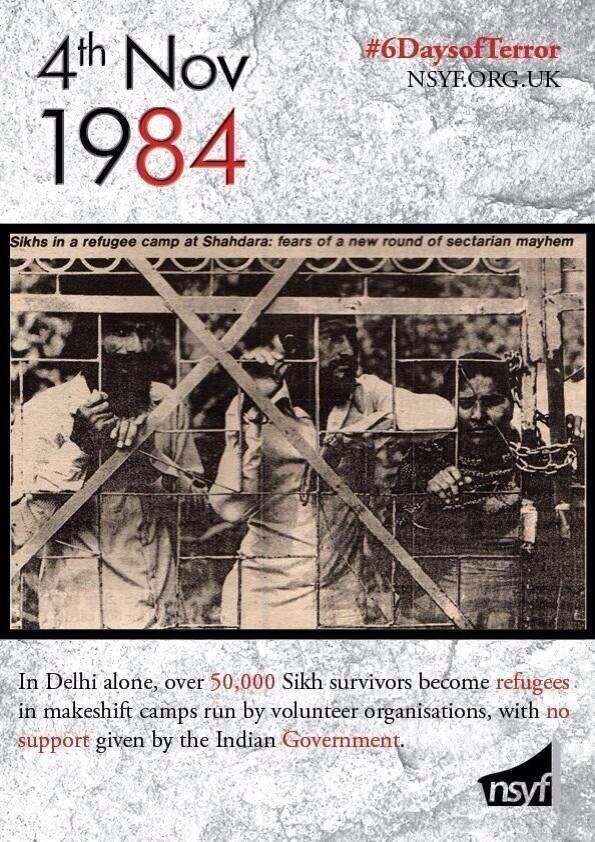
There was no escape for Sikhs caught in the sight of the mobs. In Trilokpuri, Sikhs defended their Gurudwara in Block 32 until 3:30 p.m. on November 1. Once they succumbed to the attacking mob, two Sikhs ran towards the open fields. They jumped the barbed wire and hid themselves in the tall grass, but the mob set the field on fire from several ends, burning the field and the Sikhs alive.
|
In Block 32, all but six male Sikhs were killed. In FIR No. 416 /84 of Police Station Delhi Cantt., Baljeet Kaur described how the mob returned seven times before finding her father, axing his abdomen and head, and burning him alive. In front of government offices in Shastri Bhavan, one group of assailants even burned down the house of MP Ram Vilas Paswan, because he refused to hand over a Sikh to whom he had given shelter. While Paswan escaped, the Sikh burned to death in Paswan's garage.
Assailants purposefully hunted Sikhs, and made sure to kill those Sikh males it identified, even where it could have easily let Sikhs escape. In an interview with Nandita Haksar and Uma Chakravarti, Gurmeet Singh Gill described how a mob chased a young Sikh boy dressed as a girl:
[A]s we were standing just near the house, where I was being sheltered, we saw a child of about ten, dressed in a salvar-kameez, who was moving on the road. The child was walking quite normally down the street. He was actually a young boy in the process of fleeing to safety and had been dressed as a girl. Something about the child's appearance made the mob suspect that the child was a boy and someone shouted 'sardar ka ladka hoga (it must be the son of a Sardar).'
The child panicked and started running but the mob pursued him and caught him. They asked him where the other members of his family were. The boy was really frightened and he pointed in a certain direction and said that his father was lying there and that he was dead. To my horror the mob dragged the boy up to the father's body, threw the child on him and burnt him saying 'yeh sap ka bachcha hai, ise bhi khatam kar do (This is the son of a snake, finish him off also).'
The mob did not act in haste or blindly, comfortable in the police protection. As Madhu Kishwar, founder and editor of Manushi, wrote in "Gangster Rule":
Many eyewitnesses confirm that the attackers were not so much a frenzied mob as a set of men who had a task to perform and went about it in an unhurried manner, as if certain that they need not fear intervention by the police or anyone else.
When their initial attacks were repulsed, they retired temporarily but returned again and again in waves until they had done exactly what they meant to do – killed the men and boys, raped women, looted property and burnt houses. This is noteworthy because in ordinary, more spontaneous riots, the number of people injured is usually observed to be far higher than the number killed.
Instead of being overwhelmed by sorrow from the death of their leader Mrs. Gandhi, as the police and government claimed, or exhibiting signs of coercion or social pressure, witnesses like ND Pancholi, General Secretary of Citizens for Democracy, saw the mobs dancing, laughing merrily as Sikhs burned to death.
Aseem Shrivastava, the Masters student from Delhi School of Economics, said the mob "seemed to be jubilant that 'at last the Sikhs were being taught a lesson'". Madan Lal Khurana, senior leader of the Bharatiya Janata Party (BJP) who later served as Chief Minister of Delhi, saw the mob playing drums in one or two places while people in the mob danced.
Gangs of assailants, with the complicity and help of the Railway Protection Force, boarded trains, dragged Sikhs out, burned them, and then either left them on the platform or threw them onto the tracks. The police watched, and did not bother to intervene or escort Sikh passengers off the train.
An annexure filed by the Railway Protection Force, in response to interrogatories from the Misra Commission, reports 46 unauthorized stoppages between stations by gangs of assailants. (See Appendix IV) The complicity and participation of the Railway Protection Force in these massacres is discussed in Chapter 3.
Sexual Violence
The rampaging mobs humiliated, sexually molested and raped surviving Sikh women. In Manushi, Madhu Kishwar highligh ted the story of Gurdip Kaur, a survivor of the massacre in Trilokpuri. The mob killed Gurdip Kaur's husband and three sons. They raped her in front of her youngest son and then, after he had witnessed the devastation of his mother, they killed him.
According to Gurdip Kaur, most of the Sikh women in Trilokpuri suffered gang rape, from nine and ten year old girls to 80-year old women. In several cases, elderly women were raped in front of their families. The rapists then either took the women home with them, or left them naked in the streets.
On November 1, after a day of killings, 150 to 200 women took refuge in a park in Trilokpuri while their male family members hid from view. That night, assailants came and, shining flashlights in their faces, took women to shanties. Tehmi Devi described how assailants raped her and threatened to kill her if she screamed. They tore off her clothes and stabbed her in the leg.
After raping her, they stole her jewelry and watch. Sadora Singh described the recovery of two women who were raped all night in Trilokpuri. Victims reported that a Congress (I) block leader had directed the rapists. One victim reported that ten men raped her.
Padmi Kaur, from Sultanpuri, narrated the brutal experiences of her family on November 1:
After some time the mob arrived, broke open our door and came inside. They caught hold of my daughter Maina Kaur forcibly and started tearing her clothes. In her self-defence my daughter also tore their clothes and also hit them. They tried to criminally assault my daughter. My husband begged them to let her go. They mob said they would kill him "Kohyibhi Sikh ka bacha nahin bachega" (No Sikh son would be spared). They broke the hands and feet of my daughter and kidnapped her. They confined her in their homes for three days.
Padmi Kaur listed several members of the mob, including Congress (I) leader Brahmanand Gupta. She related how her daughter was ill and " has become like a mad girl, " and how, using an inflammable chemical powder, the mob killed her husband, son, neighbor, two brothers, two nephews, and two brothers-in-law all in front of her.
Dr. H. K. Bovenanker, the Medical Officer in charge of Guru Nanak Hospital, Shanti Nagar, Kanpur, went to a relief camp on November 2 with Dr.
H. Bhatia. There they saw at least 12 to 13 cases of gang rape of young girls between the ages of 16 and 20. They had been raped on the instructions of Shiv Mangal Singh, a Congress (I) leader. On November 7, the local police recovered six girls from the village of Chilla Gaon, who had been abducted from Trilokpuri.
Several factors contributed to the under-reporting of rape. First, societal shame silenced the victims. As Gurdip Kaur told Kishwar, "The unmarried girls will have to stay unmarried all their lives if they admit that they have been dishonoured. No one would marry such a girl." Survivors used euphemistic language to describe what happened. Sarabjeet Singh saw his pregnant wife stripped naked in the middle of the road and "dishonoured."
After the mob also dishonoured his sister-in-law, they poured acid on the bodies of the two women. Second, doctors intimidated women from getting a medical examination and registering complaints. Third, in India, rape cases are medico-legal cases that require special evidential procedures which doctors in relief camps could not follow. These doctors failed to refer women to competent hospitals. Fourth, the majority of the investigating officers of the Misra Commission were probably men and failed to elicit the personal testimonies from victims.
Refusal of Medical Care
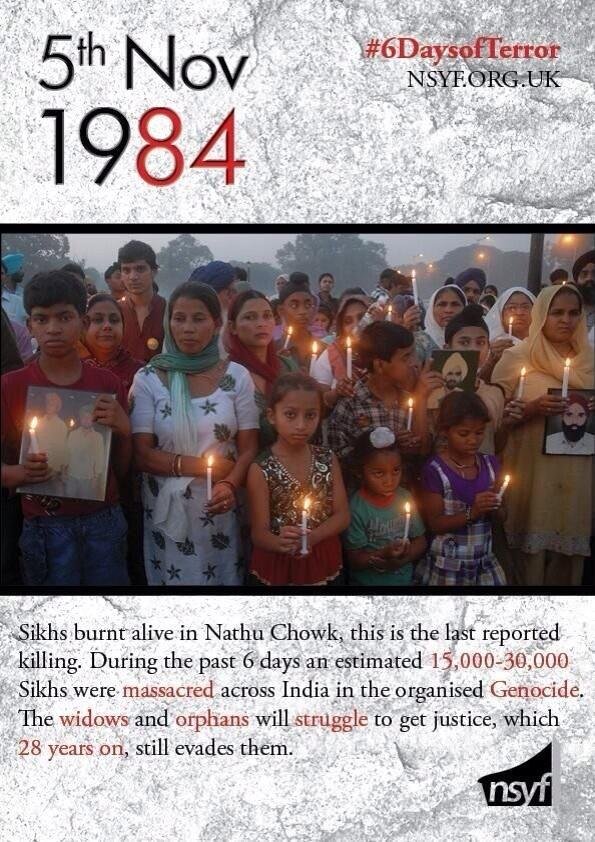
When survivors managed to reach hospitals, after witnessing the brutal murders of loved ones and risking exposure in the streets, the hospitals refused to treat them either because of animus against Sikhs or threats from assailants. This had devastating consequences for the victims.
|
At the Guru Nanak Hospital in Kanpur, Paramjit Singh was asked to either cut his hair or leave, because an assailant who had been inside the hospital earlier had spotted him. Kuldip Singh, an activist with the national civil rights organization People's Union for Democratic Rights, waited one and a half days at Daltonganj Hospital, after a mob had boarded his train and tried to kill him. He received treatment only after his non-Sikh friends threatened the doctors.
Gurdial Singh's son was shot in the head and taken to the Orsale Hospital Parade in Kanpur. His son received no treatment the whole night, and it was not until the next morning, on November 2, that he was operated on. He died the next day. Amarjit Kaur, widowed during the massacres, took her daughter-in-law, a rape victim to the hospital in Kanpur.
Dr. B.M. Pandey refused to admit her. At Sri Ganga Ram Hospital in Delhi, the doctor also refused them admission. Only after fourteen days, did she manage to receive treatment. By then, she was paralyzed from waist down.
Doctors often refused to register medical certificates or properly record injuries for further legal investigations. Balwinder Singh was from Sarai Rohilla in New Delhi. He described how the Railway Protection Force shot at Sikhs defending the gurdwara. The mob attacked the gurdwara and threw his son down from the roof. Then they came down and beat his son's head with an iron rod. Sprinkling kerosene oil on him, they set Balwinder Singh's son on fire. His son started running for the house, and miraculously escaped the mob.
Balwinder took him to Hindu Rai Hospital but was refused treatment. He then went to the Lok Nayak Jai Prakash Narain Hospital in New Delhi, where his son died on November 2 at 9:30 p.m. The doctors did not conduct an investigation into his death. Dr. I.N. Tiwari refused to prepare a medico-legal certificate and wrote the cause of death as burns and hypovolumnic shock.
A doctor at Bara Hindu Rao Hospital also refused to record a medico-legal certificate for Ravail Singh, saying he should be thrown in the nallah (stream). Ravail Singh was inside Gurudwara Sarai Rohilla when the Railway Protection Force fired on it. He managed to escape the gurudwara attack but suffered injuries later when a gang attacked his business.
Attacks on the Media
Assailants attacked journalists trying to capture and record the horrific crimes. As correspondent Mark Litke related, one gang attacked an ABC-TV crew filming in the streets, stealing cameras and equipment. The police and military guards merely watched during the attack. When survivors at the Punjabi Bagh police station started narrating their experiences to a reporter, a police officer expelled the reporter because the victims were allegedly "too depressed" to be interviewed.
American television correspondents reported that their satellite transmission facilities were "broken" and they could not send images abroad. Nevertheless, reporters still ventured out to capture the horrors of the Sikh massacres, providing some of the most thorough affidavits to the Misra Commission.
Further Questions
The affidavits provide concrete information on the characteristics of the plan implemented to facilitate the massacres of Sikhs. The organization of meetings and provision of money and weapons; the use of government-issued ration and voter lists; the large-scale provision and distribution of expensive materials, specifically kerosene and combustible chemical substances; and the immediate coordination of transportation, among other things, speak to the prior existence of a plan to massacre Sikhs that merely required implementation.
However, we lack information on who designed the plan, when the plan was designed, and what motivated the construction of the plan. How many of those who led mobs, held meetings, and distributed kerosene learned of the plan upon its implementation, and how many participated in the planning process?
The cruelty of the mobs in humiliating and degrading Sikhs before murdering them, as well as desecrating their bodies, highligh ts again the need to understand the perpetrators' motives. After the massacres, when civil society organizations raised an outcry, perpetrators did not excuse their actions by citing coercion or psychological pressure. Instead, like Rajiv Gandhi, they tried to justify the massacres by citing celebrations by Sikhs, among other excuses.
When doctors refused to provide medical care, or proper medico-legal certificates, did they act on their own animus, or did they receive sanction from higher levels of the hospital administration? Who sanctioned the coverage by the national state-operated TV station of mobs raising slogans of extermination against Sikhs?
Madhu Kishwar's study shows that women suffered sexual violence, although we have no understanding of the extent of rape and other sexual crimes. How many women were abducted and for how long were they forced to live with their captives? How did other residents in the villages, like Chilla Gaon, react when kidnappers brought captive Sikh women to live with them?
Although the affidavits allow us to identify the gamut of crimes and the identity of visible perpetrators, the answers to the above questions would explain the depth of the pre-planning of the massacres and the extent of participation by different sectors of Indian society.
The above article is an extract of 'Twenty Years Of Impunity' which is a report by Jaskaran Kaur, Ensaaf (2006).