


-

- DISCOVER SIKHISM
- SIKH GURUS
- Sikh Gurus
- Sri Guru Nanak Sahib Ji
- Sri Guru Angad Sahib Ji
- Sri Guru Amar Das Sahib Ji
- Sri Guru Ram Das Sahib Ji
- Sri Guru Arjan Sahib Ji
- Sri Guru Hargobind Sahib Ji
- Sri Guru Har Rai Sahib Ji
- Sri Guru Harkrishan Sahib Ji
- Sri Guru Tegh Bahadur Sahib Ji
- Sri Guru Gobind Singh Sahib Ji
- Sri Guru Granth Sahib Ji
- GURDWARAS
- SIKH LIBRARY
- DAILY HUKAMNAMA
- MORE
- KIRTAN
- LIVE TV
- ABOUT US

1984 Delhi Sikh Genocide - Sequence Of Events
|
|
|
|
|
|
|
|
Based on statements made before the Commission, its visits to relief camps and affected areas, contemporary newspaper accounts and information gathered from other sources available, the sequence of events appears to have been as follows:
31 October 1984:
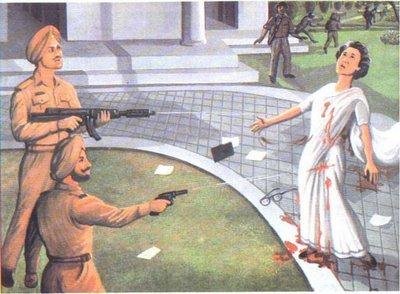
Indira Gandhi was killed for carrying out
|
9.15 am: Indira Gandhi was shot by two of her security guards at her residence No. 1, Safdarjung Road, and rushed to All India Institute of Medical Sciences.
10 am: News of the attempt first heard on the BBC.
11 am: Announcement on All India Radio specifying that the guards who shot Indira Gandhi were Sikhs. A big crowd was collecting near AIIMS.
2.30 pm: Evening editions of several papers in the capital carried news of the late Prime Minister having succumbed to her injuries. Crowds had begun gathering at the AIIMS. Stray incidents of Sikh by-passers being assaulted occurred.
4 pm: Rajiv Gandhi returned from West Bengal and reached AIIMS. Stray incidents of attacks on Sikhs in and around that area.
5.30 pm: The President of the Republic arrived at Palam on his return from an official foreign visit. He drove straight to the AIIMS. "The cars in his entourage were stoned when approaching the hospital.
6 pm: All India Radio announced Shrimati Indira Gandhi's death.
Thereafter, the crowds went on a rampage in several parts of Delhi, particularly in areas adjacent to the AIIMS, namely, Safdarjung Enclave, Laxmibai Nagar, INA Market and South Extension.
6.50 pm: Rajiv Gandhi sworn in as Prime Minister.

This is the car of Giani Zail Singh,
|
By the late evening, outbreaks occurred in areas as far afield as New Friends Colony, Lajpat Nagar, Karol Bagh and New Delhi. Gurdwaras, houses, shops, factories, workshops and other property belonging to Sikhs were looted and damaged or destroyed. Sikh pedestrians and passengers (dragged out of cars or buses) were assaulted.
Mobs fanned out in different directions from AIIMS. The violence against Sikhs spread, starting in the neighbouring constituency of Congress councillor Arjun Dass. The violence included the burning of vehicles and other properties of Sikhs. That happened even in VIP areas like the crossroads near Prithviraj Road where cars and scooters belonging to Sikhs were burnt.
Shortly after Rajiv Gandhi was sworn in as Prime Minister, senior advocate and Opposition leader Ram Jethmalani met home minister P.V. Narasimha Rao and urged him to act fast and save Sikhs from further attacks. Delhi's lt governor P.G. Gavai and police commissioner S.C. Tandon visited some of the violence-affected areas. Despite all these developments, no measures were taken to control the violence or prevent further attacks on Sikhs throughout the night between October 31 and November 1.
1 November 1984:
Several Congress leaders held meetings on the night of October 31 and morning of November 1, mobilising their followers to attack Sikhs on a mass scale. The first killing of a Sikh reported from east Delhi in the early hours of November 1. About 9 am, armed mobs took over the streets of Delhi and launched a massacre. Everywhere the first targets were Gurudwaras – to prevent Sikhs from collecting there and putting up a combined defence.
Mobs were armed with iron rods of a uniform size. Activist editor Madhu Kishwar saw some of the rods being distributed among the miscreants. Mobs also had an abundant supply of petrol and kerosene. Victims traced the source of kerosene to dealers belonging to the Congress party. For instance, a Congress worker called Brahmanand Gupta, a kerosene dealer, figures prominently in affidavits filed from Sultanpuri.
Every police station had a strength of about 100 men and 50-60 weapons. Yet, no action was taken against miscreants in most places. The few places where the local police station took prompt measures against mobs, hardly any killings took place there. Farsh Bazar and Karol Bagh are two such examples. But in other localities, the priority of the police, as it emerges from the statement of the then police commissioner S.C. Tandon before the Nanavati Commission, was to take action against Sikhs who dared to offer resistence. All the Sikhs who fired in self-defence were disarmed by the police and even arrested on trumped up charges.
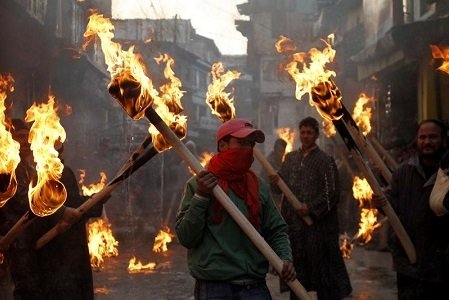
Mobs were led by affluent hindus. |
Mobs generally included teams attending to specific tasks. When shops were to be looted, the first team that gets into action would kill and remove all obstacles. The second team specialises in breaking locks. The third team would engage in looting. And the fourth team would set the place on fire.
Most of the mobs were led by Congress members, including those from affluent families. For instance, a Youth Congress leader called Satsangi led a mob in the posh Maharani Bagh. The worst affected areas were however far flung, low income colonies like Trilokpuri, Mongolpuri, Sultanpuri and Palam Colony.
The Congress leaders identified by the victims as organisers of the carnage include three MPs H.K.L. Bhagat, Sajjan Kumar and Dharam Dass Shastri and 10 councillors Arjan Dass, Ashok Kumar, Deep Chand, Sukhan Lal Sood, Ram Narayan Verma, D.R. Chhabbra, Bharat Singh, Vasudev, Dharam Singh and Mela Ram.
The violence continued to spread and increased in intensity and barbarity, especially in congested areas such as Trilokpuri, Kalyanpuri, Gandhi Nagar, Sultanpuri, Mangolpuri, Janakpuri and Palam Colony.
Akashvani and Doordarshan concentrated throughout the day primarily on crowds converging upon Teen Murti House, or filing past the bier, to pay their homage to the departed leader. There were also occasional interviews with members of the public. Viewers and listeners heard the provocative slogans raised by occasional groups among the mourners e.g., 'khoon ka badla khoon se lenge'.

Indians celebrating Sikh genocide. |
Several Members of Parliament, distinguished citizens and many other individuals reportedly made pleas to the police for assistance in different areas. Virtually the uniform answer received was that they had inadequate manpower to enable them to cope with the situation. Numerous casualties, preponderantly Sikh citizens, had been admitted to hospitals with varying injuries. Those killed by miscreants were estimated at about 60 in Delhi.
The Army was then reportedly called in aid of the civil power followed by 'shoot at sight' orders.
The then Home Secretary was reported to have said that the situation would be brought under control by the evening of Friday, 2 November. He also said that there had been only a few clashes in which a total of ten people had been killed throughout the country. Of these, five had died in Delhi one in police firing, three in an exchange of fire between two groups while one had been stabbed.
The Lt. Governor reportedly felt that for the present there was no need to set up camps where people who were insecure could be moved. The presence of troops, according to him, would make that unnecessary.
Indefinite curfew was imposed after 6pm.
2 November 1984:
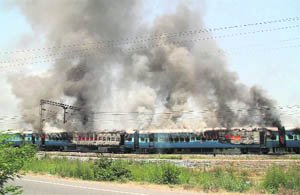
Mobs attacked trains |
Curfew was in force throughout Delhi – but only on paper. The Army was also deployed throughout Delhi but nowhere was it effective because the police did not co-operate with the soldiers who were not empowered to open fire without the consent of senior police officers or executive magistrates. Meanwhile, mobs continued to rampage with the same ferocity.
Reports appeared of an increase in the orgy of violence, arson, mayhem, rapine and murder; of Sikh passengers on trains being murdered; and of trains approaching Delhi being forcibly stopped by crowds in outlying areas in order to enable them to attack Sikh passengers.
As a large number of victims who had been rendered homeless fled in terror to available shelters provided by voluntary effort, no less than eighteen unofficial relief camps came into being.
3 November 1984 - The day of the cremation:
It was only towards the evening of November 3 that the police and the Army acted in unison and the violence subsided immediately after that. Whatever violence took place the next two or three days was on a much smaller scale and rather sporadic.
The former Lt. Governor proceeded on leave and the then Home Secretary was appointed Lt. Governor in his place.
Large contingents of the armed forces and police were deployed for duties in connection with the funeral arrangements and to escort visiting foreign dignitaries.
Section 144 Cr.P.C. orders were relaxed from 9 am to 8 pm. Indefinite curfew was re-imposed in the capital, except in New Delhi district, from 8 pm.
The first signs of abatement in the intensity of mob depravity became evident. Apprehensions of renewed violence on the night of the cremation proved unfounded. There was also evidence of an increased effect of the army's presence and more effective enforcement of the curfew.
4 November 1984 - The day of the cremation:
Incidents of violence continued but there was an overall abatement and the law and order situation in the capital appeared to be limping back to normal.
According to official reports, persons had been arrested by 4 November on charges of arson, rioting and looting. A few arrests were also made for curfew violation. However, none appeared to have been arrested for murder. The Lt. Governor is reported to have said that 458 persons had been killed including seventeen who had died in police firing. Non-official estimates at the time put the figure at about a thousand killed.
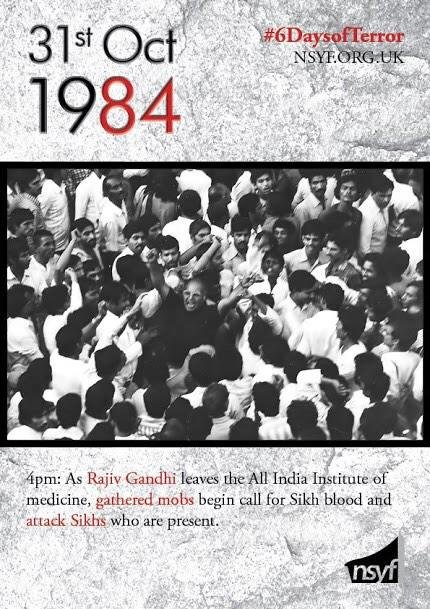


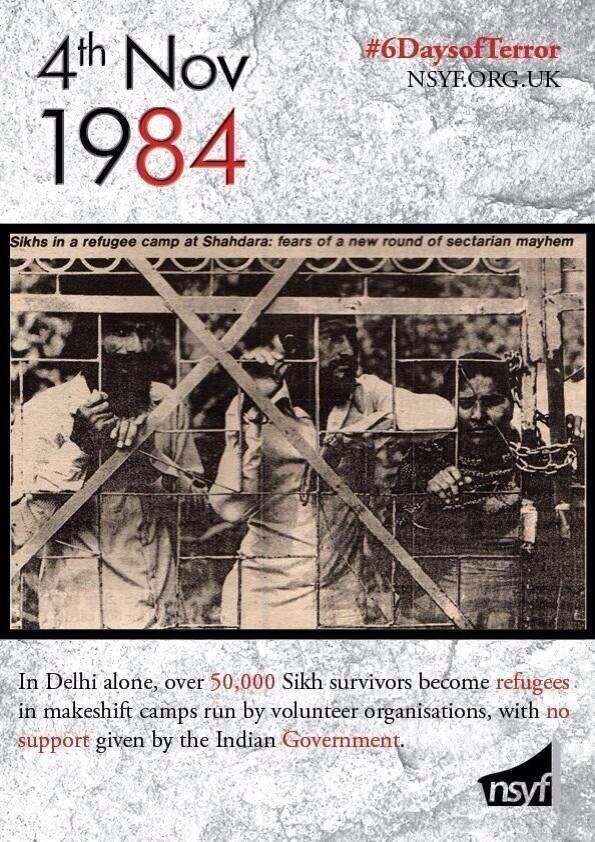
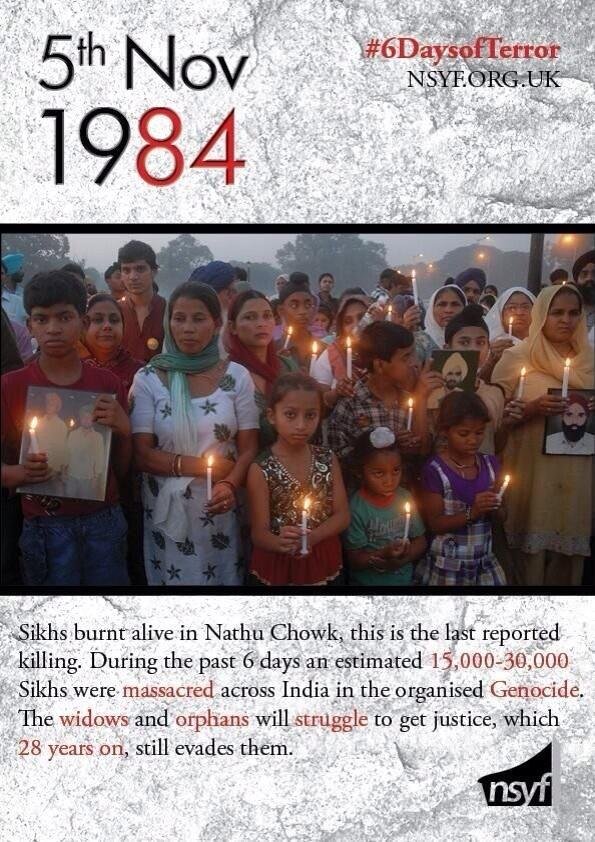
(Click on images to view 6 days of State Terror)
Aftermath Of The Carnage:
Most of the arrested miscreants were released at the earliest. But the Sikhs arrested for firing in self-defence generally remained in detention for some weeks. Worse, there was also a pattern throughout Delhi of the police not registering proper cases on the complaints of victims. Instead, the police registered vaguely worded omnibus FIRs which did not deal with any specific incident or person. As if the damage done by such FIRs was not bad enough, the police made little effort to investigate the cases and trace the miscreants. The only acknowledgement of any wrongdoing on their part was the appointment of a committee headed by senior police officer Ved Marwah to probe the role of the police.
Two remarkable initiatives that came on the same month as the carnage, in a bid to make up for the failure of the Government, were from human rights organisations and a leading Opposition party. People's Union of Civil Liberties and People's Union for Democratic Rights came out with a devastating expose in a booklet titled, Who are the guilty? The Bharatiya Janata Party contradicted the Government's claim then that only 600 people were killed in the Delhi carnage. On the basis of a survey done by its cadres, the BJP came out with a death toll of 2,700, which is remarkably close to the official tally of 2,733 arrived at three years later.
You can read the report here:

Who Are The Guilty?
(1984) This report was one of the initial documents issued on 1984 genocide of Sikhs in Delhi and other parts of India in the month of November 1984.
On December 27, 1984, the Lok Sabha elections were held and the Congress party had a landslide victory bagging over 400 seats for the first and so far the only time in the Indian electoral history. The election held under the shadow of Indira Gandhi's assassination and the subsequent massacre was marked by an anti-Sikh sentiment whipped up by the Congress party campaign.
In the early months of 1985, two more NGO reports followed: one by Citizens for Democracy headed by Justice V.M. Tarkunde and another by a Citizens' Commission headed by former chief justice of India S.M. Sikri. Both indicted the Government and the ruling party and called for a judicial inquiry.
A journalist, Rahul Kuldeep Bedi, filed a writ petition in the Delhi high court seeking an inquiry into the role of the police. PUDR filed a writ petition in the same court seeking a direction to the Government to appoint a Commission of Inquiry. Both the petitions were dismissed.
On April 26, 1985, i.e. almost six months after the carnage, the Rajiv Gandhi Government appointed the Ranganath Misra Commission to inquire into “the allegations in regard to the incidents of organised violence” in Delhi.
In June 1985, a group of eminent persons and representative of human rights organisations came together under the banner of the Citizens Justice Committee (CJC) to help the Misra Commission unravel the truth.
The Misra Commission held all its proceedings in camera and took the help of the CJC to get affidavits from victims.
On March 31, 1986, the CJC notified its withdrawal as the Misra Commission kept it out of most of the inquiry holding “in camera proceedings within in camera.”
In August 1986, the Misra Commission submitted its report to the Government, which in turn tabled it in Parliament in February 1987. The report vindicated the CJC's apprehension that the Misra Commission would whitewash the role of the Government and the ruling Congress party.
On February 23, 1987, the Government appointed three committees on the recommendation of the Misra Commission. (1) Jain-Banerjee committee to pursue cases that have either not been registered or not properly investigated. (2) Kapur-Mittal committee to identify delinquent police officials. (3) Ahooja committee to arrive at the official death toll of the carnage.
In August 1987, the Ahooja committee determined that the number of persons killed in Delhi in the 1984 carnage were 2,733.

Sikh Genocide - What if this was your father? |
In November 1987, the Delhi high court stayed the functioning of the Jain-Banerjee committee because of its very first recommendation, which was to register a murder case against former Congress MP Sajjan Kumar. The petition was filed by one of the co-accused, Brahmanand Gupta.
In October 1989, the Delhi high court quashed the notification appointing the Jain-Banerjee committee. The court found that the powers of monitoring of investigation and the institution of new case conferred on the committee were illegal.
March 1, 1990: The two members of the Kapur-Mittal committee gave separate reports. Justice Dalip Kapur gave no finding on the ground that the committee had not been empowered to summon police officials to hear their version. Kusum Lata Mittal identified 72 police officials, including six IPS officers, recommending various penalties against them.
March 27, 1990: The Delhi Administration prompted by the newly elected V.P. Singh Government appointed the Poti-Rosha committee without the legal defects pointed out by the high court in the case of the Jain-Banerjee committee.
August-September 1990: The Poti-Rosha committee sent two batches of recommendations covering altogether 30 affidavits, including the case against Sajjan Kumar. When a CBI team went to his house to arrest him, Sajjan Kumar and his supporters locked up the officials and detained them till his lawyer, R.K. Anand (now a Congress MP), obtained “anticipatory bail” from the high court. Subsequently, the two committee members, Subramaniam Poti and Padam Rosha, declined to carry on in office when their first term expired on September 22.
October-November 1990: The Delhi Administration constituted a fresh committee comprising J.D. Jain and D.K. Aggarwal, to take over the work of the Poti-Rosha committee.
June 30, 1993: After making recommendations from time to time from among the remaining 1,000-odd affidavits, including 21 affidavits against Congress leaders H.K.L Bhagat and Sajjan Kumar, the Jain-Aggarwal committee submitted a detailed report giving a comprehensive account of how the police scuttled carnage cases at the stages of registration, investigation and prosecution. The Jain-Aggarwal committee also recommendation action several police officials for their lapses.
1994: The Delhi Government under Madan Lal Khurana appointed an Advisory Committee under the chairmanship of Justice R.S. Naroola. The Advisory Committee reviewed the status of the recommendations made the Poti-Rosha committee, Jain-Aggarwal committee and Kapur-Mittal committee. The Advisory Committee also made a particular reference to the failure of the police, which came under the Congress-ruled Central government, to book the cases recommended against Congress leaders H.K.L. Bhagat and Sajjan Kumar.
1995: On the basis of the Advisory Committee's report, Delhi chief minister Madan Lal Khurana repeatedly asked the Centre to let the police take action on the 21 affidavits against Congress leaders H.K.L. Bhagat and Sajjan Kumar. It was only when Khurana threatened to complain to the National Human Rights Commission, the Centre sent those affidavits to the Delhi Government.
2000: The Atal Behari Vajpayee Government appointed a fresh judicial inquiry into the 1984 carnage under the chairmanship of Justice G.T. Nanavati. The justification offered for it was the failure to punish the guilty. Despite the lapse of over 15 years, the Nanavati Commission received hundreds of fresh affidavits from victims as well as victims, including prominent persons such as I.K. Gujral, Khushwant Singh, Kuldip Nayar and Jagjit Singh Aurora.
2001-02: The Nanavati Commission records much damaging evidence brought on record for the first time since 1984.