


-

- DISCOVER SIKHISM
- SIKH GURUS
- Sikh Gurus
- Sri Guru Nanak Sahib Ji
- Sri Guru Angad Sahib Ji
- Sri Guru Amar Das Sahib Ji
- Sri Guru Ram Das Sahib Ji
- Sri Guru Arjan Sahib Ji
- Sri Guru Hargobind Sahib Ji
- Sri Guru Har Rai Sahib Ji
- Sri Guru Harkrishan Sahib Ji
- Sri Guru Tegh Bahadur Sahib Ji
- Sri Guru Gobind Singh Sahib Ji
- Sri Guru Granth Sahib Ji
- GURDWARAS
- SIKH LIBRARY
- DAILY HUKAMNAMA
- MORE
- KIRTAN
- LIVE TV
- ABOUT US

1984 Delhi Genocide - Responsibility For Genocide
|
|
|
|
|
|
|
|
The whole point of the elaborate cover-up over the years of the 1984 carnage was to shield the Congress leaders alleged to have organised the killings. The cover-up began even as the carnage was still going on. The cases registered during the carnage and in the immediate aftermath made no mention of any of the Congress leaders.
In fact, their names came out in the open for the first time only when the famous PUDR-PUCL report 'Who are the guilty?' was released weeks later. The report named the leaders on the basis of allegations made by the victims taking refuge in relief camps. In the anti-Sikh frenzy whipped up then by the "secular" Congress party, some of the leaders named in the PUDR-PUCL report were promoted after the Lok Sabha elections held within two months of the carnage.
Rajiv Gandhi elevated H.K.L. Bhagat, MP of the worst affected area of the Capital, East Delhi, from the rank of minister of state to Cabinet minister. Another Delhi MP Jagdish Tytler became a minister of state for the first time. Lalit Maken was elevated from the rank of a councillor to an MP.
Reward For Genocide
The Misra Commission, which otherwise whitewashed the role of the Congress party and its leaders, conceded that the police desisting from recording any allegations against influential persons.
"It is a fact and the Commission on the basis of satisfaction records a finding that first information reports were not received if they implicated the police or any person in authority and the informants were required to delete such allegations from written reports. When oral reports were recorded, they were not taken down verbatim and brief statements dropping out allegations against police or other officials and men in power were written," said the Misra Commission.

Police Protect Hindu Ring Leaders
The Jain-Banerjee Committee set up on the Misra Commission's recommendation was the first official agency to have defied the cover-up and tried to register a case against a Congress leader. In October 1987, it instructed the Delhi police to register a murder case against Sajjan Kumar, who was Congress MP during the carnage from the outer Delhi constituency, on the basis of an affidavit filed a riot widow, Anwar Kaur. But for two months, the police sat on the Jain-Banerjee committee's instruction.
When journalist Manoj Mitta exposed this fact in The Times of India, one Brahmanand Gupta, who was also named in Anwar Kaur's affidavit, obtained a stay on the Jain-Banerjee committee from the Delhi high court. The matter was stuck in the court for two years. The CBI got around to registering the case only in 1990. It took another two years to complete the investigation but even then, it did not file a challan against Sajjan Kumar. That's because, in addition to charging him with murder, the CBI chose to accuse him of fomenting hatred between two communities.
The relevant provision, Section 153A of Indian Penal Code, requires the investigating agency to take the Centre's sanction before filing such a chargesheet. Bowing to the pressure of the BJP's Madan Lal Khurana Government in Delhi, the Congress party's Narasimha Rao Government at the Centre ultimately gave its sanction in June 1994. Subsequently, the CBI filed the charge sheet in December 1994, that is full 10 years after the carnage. The case is still pending.
Delaying Tactics
Another official panel, the Jain-Aggarwal Committee, recommended registration of two cases in 1991 against H.K.L. Bhagat. The then Lt. Governor of Delhi, Markandeya Singh, accepted the committee's recommendation. But Bhagat made a representation before him claiming that he had already been exonerated by the Misra Commission and therefore no case could be registered against him.
Markandeya Singh referred Bhagat's representation to the Jain-Aggarwal Committee, which held that there was no bar on registration of cases against Bhagat as the Misra Commission's view was only prima facie and not a final exoneration.
Since the Congress party had by then returned to power at the Centre, Bhagat brought a lot of pressure on Markandeya Singh. Fortunately, Markandeya Singh proved to be a man of convictions as he gave a direction for the registration of those cases against Bhagat.
Indian Police Above The Law
As it happened, in spite of the Lt Governor's direction, the police baulked at registering the cases recommended against Bhagat. Worse, Markandeya Singh was removed from office for daring to take on Bhagat. The police finally registered the two cases in question only after the Congress party was voted out of power at the Centre in 1996.
The Jain-Aggarwal Committee recommended registration of cases against other politicians as well in 1991. And Markandeya Singh duly directed registration of all those cases. Given the courage and sincerity displayed by him, it can said that among all the Government functionaries Markandeya Singh's contribution to the cause of securing justice to carnage victims was the greatest.
The other Government functionary who played a major role in this regard was Madan Lal Khurana, who put the carnage issue on the political agenda of Delhi. But while Khurana received political dividends for pursuing this cause, Markandeya Singh sadly paid with his job for refusing to be party to a cover-up.
Misuse Of The Law
Having got rid of him, Congress leaders hatched a conspiracy to scuttle the recommendations put on record by Markandeya Singh. The Narasimha Rao Government made sure that all the stronger cases, which had a good chance of going to trial, were suppressed, while the weaker ones were registered so that the police could close those cases without sending them for trial. Clearly, the idea was to pretend to have acted on Markandeya Singh's recommendations without leaving any scope for arraigning any of the Congress leaders in the carnage cases.
This elaborate cover-up of the Government exposed by journalist Manoj Mitta and advocate H.S. Phoolka. Mitta first learnt that the cases booked against politicians had little chance of success as the witnesses concerned happened to back out. Mitta ferreted out the names of the victims who were said to have developed second thoughts about making allegations against any politician.
Mitta gave those names to Phoolka, who in turn dug out the affidavits filed by each of them. It turned out that none of those were in fact the main affidavits against politicians. The affidavits chosen by the police did name politicians but not in any actionable sense.
Witnesses Ambushed
The witnesses concerned stated in their affidavits that they had themselves not seen the politicians but had only heard about their involvement. Since the allegations were based purely on hearsay, Phoolka had never included them in the category of cases/ affidavits against politicians.
Phoolka then gave Mitta another list of affidavits where the witnesses had given direct evidence of having seen the complicity of political leaders. When Mitta showed that list to the police, they feigned ignorance and claimed that none of those cases had been recommended by the Jain-Aggarwal Committee. After two months of painstaking probe by Mitta and Phoolka, the following facts came to light:
• The Jain-Aggarwal Committee recommended registration of cases on 21 affidavits against politicians, primarily Sajjan Kumar in 1991.
• Markandeya Singh accepted those recommendations and directed registration of cases.
• The Delhi Government sent the affidavits to the CBI in 1991 for registration of cases.
• The CBI sent those affidavits back to the Delhi Government the same year saying that it was already overloaded with work and those matters could therefore be handled by the Delhi police.
Justice Gathering Dust
Phoolka and Mitta uncovered these facts in October 1993. The affidavits approved by Markandeya Singh were till then gathering dust in the Home Department of the Delhi Government. The news of this cover-up was broken by Mitta in October 1993 in an article in India Today magazine, where he was then employed.
Thereafter, the issue of 21 affidavit was raised in Parliament by Jagmeet Singh Brar, a young, energetic member of the Congress party. Brar got support from Janata Dal, BJP, CPM and CPI. But the Government still failed to register those cases. Such was the influence wielded by the culprits of the 1984 carnage even after nine years.
As it happened, the Delhi Assembly elections were due a month after the 21 affidavit came to light. Madan Lal Khurana, who was the chief ministerial candidate of the BJP, made the carnage an election issue. But after the BJP won the elections, the Home Department of the Delhi Government surreptitiously sent those affidavits to the Central Government, in a bid to take them out of Khurana's jurisdiction.
Congress Government Suppression
The Congress Government at the Centre did not return those affidavits to the Khurana Government despite repeated demands. Towards the end of 1994, Khurana threatened to complain to the National Human Rights Commission about the Centre's attempt to shield the political leaders involved in the 1984 carnage.
The threat worked and the Centre finally returned the affidavits to the Delhi Government. But even then Khurana could not ensure the registration of cases because the Delhi police does not come under the purview of the Delhi chief minister. Khurana had to secure orders from the then Lt Governor of Delhi, P.K. Dave. As a result, the cases were yet to be registered when Khurana demitted office in 1995.
Delhi Police Injustice
Again, under the pressure of the Khurana Government, the Delhi police registered two other cases against Sajjan Kumar on the recommendation of another official panel, Jain-Aggarwal Committee. The police closed one of those cases allegedly because of some deviations in the statements of the complainant over the years. In another case registered on the affidavit of a victim called Gurbachan Singh, the police filed a charge sheet alright but made no mention of Sajjan Kumar at all. Gurbachan Singh filed an affidavit before the Nanavati Commission bringing out the manner in which the police shielded Sajjan Kumar.
The cases against Bhagat met a similar fate. The two cases for which Markandeya Singh lost his job in 1991 were ultimately registered in 1996 after the Congress party was voted out of power at the Centre.
One of those cases is based on the affidavit of Harminder Kaur, who lost her husband, son and son-in-law in the carnage in East Delhi. In 1998, the police filed a charge sheet in the case but without levelling any charge against Bhagat. As H.S. Phoolka and his team protested Bhagat's exclusion, the magistrate directed the police to conduct further investigation. Another charge sheet was thus filed in 2000 – but again Bhagat was conspicuous by his absence in it.
Police Harassment
In effect, the police closed the case against Bhagat. This despite the fact that the police had by then examined Harminder Kaur as many as six times while they evidently felt no need to question Bhagat even once. It seemed that their main object was to wear down the victim. They succeeded in doing as Harminder Kaur, aged as she is, has developed symptoms of amnesia and has given up all hope of ever getting justice.
At the instance of Phoolka and his team, the Lt Governor of Delhi, Vijai Kapoor, referred Harminder Kaur's case for the legal opinion of additional solicitor general K.K. Sud. Not surprisingly, Sud severely castigated the police for shielding Bhagat. Subsequently, Kapoor sent Harminder Kaur's case to the CBI where it is still pending.
Hindu Mobs And Politicians Above Indian Law
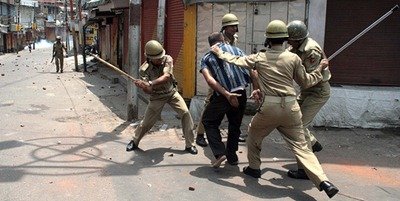
Despite the police's obvious efforts to shield him, Bhagat did get arrested in 1995 for his role in the carnage. It happened purely because of the courage and integrity displayed by additional sessions judge S.N. Dhingra. He issued non-bailable arrest warrants against Bhagat in 1994 after one Satnami Kaur deposed before him in the course of a trial that she had seen Bhagat moving with the miscreants in East Delhi during the carnage. Bhagat appealed against that warrant and the high court dismissed his plea. It was in then that Bhagat appeared in Dhingra's court in East Delhi in January 1995 accompanied by about 10,000 supporters and 100 lawyers.
It was clearly a demonstration of strength meant to intimidate the judge. In an extraordinary display of audacity, Bhagat demanded that Dhingra must do Namaste to him in the court. When the judge pulled him up for that, Bhagat and his lawyers shouted at him. Phoolka intervened to say that Bhagat's ploy was to create an ugly scene and get the case transferred from Dhingra's court.
Subsequently, Dhingra rejected Bhagat's bail application. But before the pronouncement of the order, one of Bhagat's own lawyers whisked Phoolka out of the court from the rear entrance lest he be attacked by the mob waiting outside. Such was the environment of fear surrounding the carnage issue even as late as 1995. Bhagat was in custody for four days but he spent most of that period in a hospital as he complained of chest pain.
Sikh Treachery
But unfortunately, for all the sensation created by it, the case against Bhagat collapsed in November 1995 as Satnami Kaur went back on her allegation against him. The poor widow is believed to have backtracked allegedly at the instance of Atma Singh Lubana, a member of the Delhi Sikh Gurdwara Management Committee.
Three days after Satnami Kaur backtracked, another widow, Darshan Kaur seemed to retrieve the situation as she appeared in Dhingra's court and identified Bhagat as an organiser of the massacre in Trilokpuri, the worst affected colony in Delhi. Darshan Kaur was also brought under pressure to withdraw her allegation. But she seemed to be made of sterner stuff as she stuck by her deposition.
No Justice
Bhagat was still acquitted on the ground that in a riot case, a conviction cannot be based on the word of just one witness. The police made no effort to corroborate Darshan Kaur's statement by producing, for instance, other witnesses who could have strengthened her allegation. Phoolka filed an appeal in the high court alleging that the police did faulty investigation to favour Bhagat. The appeal is still pending.
The police registered two cases against Jagdish Tytler and both were subsequently closed. The Nanavati Commission received at least two affidavits alleging Tytler's complicity in the massacre.
You can read 'Who Are The Guilty?' here:

Who Are The Guilty?
(1984) This report was one of the initial documents issued on 1984 genocide of Sikhs in Delhi and other parts of India in the month of November 1984.
None of the three senior Congress leaders discussed here has so been convicted in a court of law. But the court of people appears to have punished them politically. When Bhagat appeared for the first time in the court in January 1995, he was accompanied by about 10,000 supporters. But when the court passed its last order in 2000, Bhagat was accompanied only by his son and security men. His political career is virtually over.
In comparison, Sajjan Kumar may still be a force to reckon with but he has repeatedly been denied Congress party tickets over the years to contest in Lok Sabha elections. It is in fact widely believed that Sajjan Kumar would in all probability have become chief minister of Delhi but for the persistent campaign against him for his role in the carnage. Tytler has also suffered several political setbacks, the last one being his defeat in the 1999 Lok Sabha elections at the hands of Madan Lal Khurana.
The political punishment is thus a result of the extraordinary tenacity displayed by Phoolka and his team, who pursued the issue all through despite all the setbacks they suffered on the way.
Men at the top in the administration and the ruling party displayed repeatedly a curious lack of concern often bordering on deliberate negligence of duty and responsibility throughout the period of October 31 to November 4. From our talks with various Opposition Party leaders and prominent citizens we found that many among them had got in touch with senior Ministers as well as people in the Delhi Administration on October 31 itself, warning of impending troubles following the announcement of Mrs Gandhi's assasination.
Lies, Damn Lies And Narasimha Rao
The newly sworn in Home Minister P.V. Narasimha Rao was said to have assured the BJP leader Atal Behari Vajpayee on October 31 evening that "everything would be brought under control within a couple of hours" (The statement, November 10, 1984).
Yet at the same time on the same day, Cautam Kaul, Additional Commissioner of Police in front of the All India Medical Institute, referring to the disturbances which were just breaking out, said: "We cannot deal with the situation of this nature". (INDIAN EXPRESS, November 1, 1984) Strangely enough, even after this, Mr. Kaul has been made Additional Commissioner, Security. Inspite of such warnings given well in advance, those in positions of authority did not seem to bother to take any firm step. (See Annexure 3).
Soon after the assassination (October 31), we heard from a reliable source, a meeting was held at 1 Safdarjung Road, the Prime Minister's official residence where the then Lt. Governor P.G. Gaval, a Congress (I) leader M.L. Fotedar and the Police Commissioner among others, met. A senior police officer present at the meeting expressed the view that the army should be called as otherwise there would be a holocaust. No attention was paid to the view.
'We Are About To Help... Or Maybe Not'
On November 1, when almost all of Delhi was aflame, an opposition MP rang up Mr. Shiv Shankar, a Minister in Rajiv Gandhi's new cabinet, and the Home Minister, Narasimha Rao, to inform them about the situation in the city and the need for army action. The Ministers were reported to have assured him that the army was about to be called and curfew would be imposed. (Several citizens including some senior government officials went to the President of India on the afternoon of November 1, and they told that the Government was still considering whether to call out the army.)
But our experience on November 1 tells a different story. As already mentioned earlier, till late night there were no signs of either curfew or army, while miscreants were on the rampage in front of the police. In the hearts of the city - Connaught Circus - Sikh owned shops were being set on fire right under the nose of heavy para-military and police pickets. We later heard that the DC of Faridabad has asked for army on November 1, but troops arrived only on November 3.
On November 2, although the newspaper that day announced three official measures (I) clamping of an indefinite curfew; (ii) shoot at sight orders; and (iii) deployment of army since 2 p.m. the previous day. When we went around South Delhi in the afternoon of November 2, we found that the miscreants were not only at large, but had swelled in numbers and had become more defiant.
In the Lajpat Nagar market, while police pickets sat by idly, hundreds of young men, armed with swords, trishuls and iron rods, blocked the main road. Around 3 pm an army convey passed through the road. The miscreants did not scamper or panic. They merely made way for the convey to pass by temporarily retreating to the by lanes, and regrouped themselves as soon as the convey left and began intimidating a peace march that had arrived on the spot.
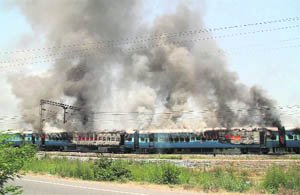
Mobs attacked trains |
Trains Attacked
On the morning of November 3, 8.30 am onwards two opposition M.P.'s repeatedly requested both Mr. Narsimha Rao and Shiv Shankar to provide army protection to trains carrying Sikh passengers arriving from punjab. No troops were sent, with the result that every train was left at the mercy of gangsters who dragged out Sikhs from the incoming train compartments lynched them, their bodies on the platforms or the railway tracks and many were set on fire.
Newspaper reported that 43 persons were killed. This was denied by Doordarshan in the evening. Visiting the Tughlakabad station around 3.30 p.m., the STATEMAN reporters saw "two bodies still smouldering on the platforms across the tracks". (November 3, 1984). The troops had either arrived after the incident, or the incident took place in front of the troops who did not intervene.
Analysing The Role Of The Administration
While analysing the role of the administration, we cannot remain content to blame the Delhi administration and the bureaucrats only. The Lt. Governor Mr. Gaval, who was in charge of administration of Delhi during the period under review and who has been replaced now, could not have acted on his own - whether they were acts of commission or omission.
Both the Delhi administration and the Union Cabinet Ministers, including the Home Minister, were well-informed of the sequence of events beginning from the evening of October 31, (as evident from the report of communications between the opposition leaders and the Cabinet Ministers are recorded earlier in this report). We are left wondering whether the Union Ministers direct and the Lt. Governor refuse to abide by their directives? in some case, should not the Union Minstry punish the Lt. Governor? But we were merely told on November 4 that Mr. Gaval had "Proceeded on leave" and that Mr. M.M.K. Wali had taken over.
What intrigues us further is the appointment of Mr. Wali as the Lt. Governor Mr. Wali was the Home Secretary before his new appointment.
The record of what happened in Delhi from October 31 to November 3 (the eve of Mr. Wali's appointment) is sufficient to prove the failure of the Home Ministry administrative machinery in suppressing riots. We wonder why the former Home Secretary, Inspite of the proved failure of an administration of which he was a leading component, has been appointed the Lt. Governor As evident from our review of official relief poperations, (Chaper III), Mr. Wali's administration seem to continue the same policy of callousness and inefficiency towards the refugees as was demonstrated in the recent past towards the Sikh victims during the riots in Delhi.