


-

- DISCOVER SIKHISM
- SIKH GURUS
- Sikh Gurus
- Sri Guru Nanak Sahib Ji
- Sri Guru Angad Sahib Ji
- Sri Guru Amar Das Sahib Ji
- Sri Guru Ram Das Sahib Ji
- Sri Guru Arjan Sahib Ji
- Sri Guru Hargobind Sahib Ji
- Sri Guru Har Rai Sahib Ji
- Sri Guru Harkrishan Sahib Ji
- Sri Guru Tegh Bahadur Sahib Ji
- Sri Guru Gobind Singh Sahib Ji
- Sri Guru Granth Sahib Ji
- GURDWARAS
- SIKH LIBRARY
- DAILY HUKAMNAMA
- MORE
- KIRTAN
- LIVE TV
- ABOUT US

1984 Delhi Genocide - Don't Cry For Us, Unbeloved Country
|
|
|
|
|
|
|
|

Ghotki in Sind was the ancestral village of Lubana Sikhs — workers of coir. Jesibai, now the matriarch seated at the centre of the portrait, crutches in hand, was 12 at the time of the Partition.
She recalls the day Nehru personally came to the village to ensure their safe passage to India, "Our Muslim Pir Mahboob Shah told Nehru he had kept count of the children he is handing over. When my children reach Bombay", he told Nehru, "not one should be missing".
We travelled by train and then boarded a ship. For three nights we saw not a single habitation, not a single gleam of light at night. But when we reached Bombay it was as Mahboob Shah had willed. Today where is Nehru? It was our own people who killed us in what they say is our land. It is not our land, it is a randikhana.
Following the migration to Bombay, tempted by the promise of land, the Lubanas moved to the farmland near Alwar. But the land could not be made to yield a harvest. Some years later they were on the move again to a slum in Shahdara.
During the Emergency, they were given a sum of money and allotted pucca houses in block 32 of Trilokpuri. "We had nothing against Indira, she had given us our houses. But someone killed her and we were made to pay," she says.
On the morning of November 1, 1984, hours after her youngest granddaughter Baby was born, the Lubanas had come out in force to defend themselves against organised mobs. The promise of a few prominent local leaders saw them head back to their houses:
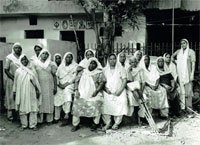
The widows of Block 32, Trilokpuri. Photographed in Tilak Vihar on August 9, the morning after the Nanavati Report was released |
"Then they came looking for us. Twenty to a house, pulling the men out, slaughtering them before our eyes. We tried to disguise some of our boys as girls but even then not all of them got away safely."
"The violence began only when HKL Bhagat came to the area. He told the mob not to spare a single male."
"The Sikhs, he said, were like serpents. If you spare the boys they will grow up to kill you. Days later he came to the relief camp at Shahdara to distribute blankets. We chased him out." This group of women lost over 50 male relatives.
Another migration followed. To the resettlement colony in Tilak Vihar. Some of the women got jobs, as 'watermen' or maalis at schools. When they would go to work there would be no one to look after the children. Few, if any of them, ever finished school.
Every household has a man addicted to drugs, several have died of addiction. But even then there are signs of renewal: abandoned by the State and by their own community, some of the sons of coolies have opened small shops, a few own autorickshaws.
And they have reasserted their identity, "After the riots all of the men had cut off their hair. But every year when we would go back to Trilokpuri we would feel ashamed. Today when they walk in the streets where the murderers of their fathers still roam free, it is clear the Sikhs have come back in greater numbers. They cannot finish us off."
Which is why they say what they want, above all, is justice. "Give us a day's leave. The same leave that was granted to those men. We will put tyres around their throats and set them afire. Without justice our curse be upon this nation. It happened to Rajiv, his children suffered the same fate our children did; they were unable to see his face in death. Let the curse spread to the entire nation."
Credit: Hartosh Singh Bal (20th August 2005)
 Back to More Important Articles To Read