


-

- DISCOVER SIKHISM
- SIKH GURUS
- Sikh Gurus
- Sri Guru Nanak Sahib Ji
- Sri Guru Angad Sahib Ji
- Sri Guru Amar Das Sahib Ji
- Sri Guru Ram Das Sahib Ji
- Sri Guru Arjan Sahib Ji
- Sri Guru Hargobind Sahib Ji
- Sri Guru Har Rai Sahib Ji
- Sri Guru Harkrishan Sahib Ji
- Sri Guru Tegh Bahadur Sahib Ji
- Sri Guru Gobind Singh Sahib Ji
- Sri Guru Granth Sahib Ji
- GURDWARAS
- SIKH LIBRARY
- DAILY HUKAMNAMA
- MORE
- KIRTAN
- LIVE TV
- ABOUT US

1984 Delhi Genocide - Boot Of The State
|
|
|
|
|
|
|
|

An angry journalist threw a shoe at India's top security official after a confrontational exchange during a press conference over the 1984 anti-Sikh riots that left thousands dead.
The shoe missed Home Minister Palaniappan Chidambaram, who continued taking questions on Tuesday as officials escorted the journalist away.
He was later taken into police custody, but it was not immediately clear whether he would face charges, said police spokesman Rajan Bhagat.
Local television channels identified the journalist as Jarnail Singh, a veteran reporter with one of India's largest newspapers, the Hindi daily Dainik Jagran.
Before throwing the shoe, Singh asked Chidambaram several questions about the Central Bureau of Investigation's findings last week that cleared a senior Congress Party leader, Jagdish Tytler, from any involvement in the bloody riots that left 3,000 dead.
Chidambaram said CBI was an independent body and the government played no role in the decision, and called for the public to be patient.
Singh, dressed in an olive-green shirt and a white turban, then threw his blue and white sneaker at Chidambaram, narrowly missing his face. Moments later, Chidambaram repeatedly asked the reporters in the room to "settle down," and said, "the emotional outburst of one man should not hijack a press conference."
Soon after, Singh told TV news reporters that he regretted throwing the shoe but he felt Chidambaram was dodging the question.
"I just wanted to ask him how justice will be done, but he was not interested in answering the questions," he told CNN-IBN during a telephone interview from police custody. "I don't think it was the right way, what I have done, but the issue is right."
Singh did not say whether he was inspired by Iraqi journalist Muntadhar al-Zeidi, who last month was sentenced to three years in prison for throwing his shoes at former President George W. Bush in Baghdad. The 1984 riots, which remain a very controversial issue in India, left more than 3,000 dead, most of whom were Sikhs.
The carnage erupted across India after former prime minister Indira Gandhi's Sikh bodyguards shot her to death.
Many blame Congress party officials for turning a blind eye or even supporting the rioters in the violence that ensued after their leader was slain.
On Tuesday, hundreds of Sikhs held protests over the CBI's findings in front of the home of Congress chief Sonia Gandhi, the daughter-in-law of Indira Gandhi.
Jagdish Tytler, the center of the controversy, was a lawmaker at the time and remains a divisive figure in Indian politics. He is currently campaigning for re-election to Parliament in elections that begin later this month.
Credit: Todays Zaman (8th April 2009)
Boot Of The State
Three myths were shattered when a diffident Sikh took off his footwear.
The flinging of a desultory shoe by an unhappy journalist at the home minister of India demands the dispelling of three different myths. The first is the self-image Indians, particularly Hindus, have of themselves: of being a tolerant and non-violent people.
Any reading of the events of those three evil days after the assassination of Mrs Indira Gandhi on 31 October, 1984, should serve as a reality check. With utter brutality, without a trace of compassion for women or children, free wheeling mobs stabbed, slaughtered and burnt more than 3,500 Sikhs.
Husbands were quartered in front of their wives, fathers set alight in the presence of their children. Rapine and pillage were ancillary activities that raged alongside.
Every single one of these Sikh victims was innocent. None of them had anything to do with the killing of the prime minister. Almost all of them were ordinary citizens going about their workaday lives. And yet the ordinary men — their fire fanned by political agency — who massacred them made nothing of these considerations.
The statistic is cold: 3,500. The eyes run past it. But take a walk through a few of the stories — the details of what was done — and the immense horror of it will come home. How did men practice such blood-lust and then — unremorsefully — return to their small homes and petty jobs, their own wives and children?
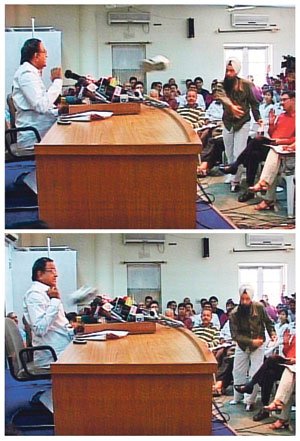
Home Minister Palaniappan Chidambaram |
It's the question that gives of no answer. And yet it leaves us with a knowledge — which we must imbibe afresh continually. That we are neither tolerant nor non-violent. In fact we possess a shopping mall range of cruelties.
We routinely practice every kind of violence: caste, gender, religious, class, language, region, and also against animals. The individual and the group cruelty segue into each other seamlessly. To confirm the thesis, those who are too young to remember 1984 can always reach for Gujarat 2002.
The second myth we need to rubbish is that we are a fair and just society. Let's be clear: the brutalised Sikhs of 1984 will never get justice. For the murder of close to 3,000 people, so far, in 25 years, there have been only 13 convictions, that too of the foot-soldiers not the officers.
Do the maths, and know that the system is committed to obfuscation not the truth. In this time, the state has installed as many as ten commissions and committees to unearth the facts. Alas, without success. So we have a corpse, actually 3,000 of them, and all in the drawing-room, but no killers.
I say in the drawing-room because unlike Gujarat 2002 — and other obscure carnages — the Sikh massacres took place in the capital of India. If the malevolent instinct of the majority — and the state — has no shame here, then its ability to rampage elsewhere is boundless.
That we are fundamentally an unjust people is borne out by the general indifference of citizens to the carnage of 1984 (and 2002). We know great wrong has been done, but we feel no moral pressure to make it right.
We all contribute to the creating of public amnesia — which allows the goons and their architects to slip through the turnstile of public censure, unrebuked and unpunished. We are neither tolerant nor non-violent. In fact we possess a shopping mall range of cruelties
The third myth calling for rejection is that symbolism is dead. The feeble throw of the shoe by Jarnail Singh was nothing but a symbolic act — and yet it immediately crystallized a million hapless frustrations.
It forced a ruling party to bow to the ire of a wronged community; it forced the exit of two very powerful politicians from the electoral arena.
It's a reminder that symbolism is still a potent force in public life. Saying the right thing, doing the right thing, can still be hugely transformative in ways we seem to have completely forgotten.
Credit: Tarun J Tejpal - Tehelka (25th April 2009)
 Back to More Important Articles To Read